



AdventureX 2014 – Part 2: The People

Theodor Waern (Hot Seat)
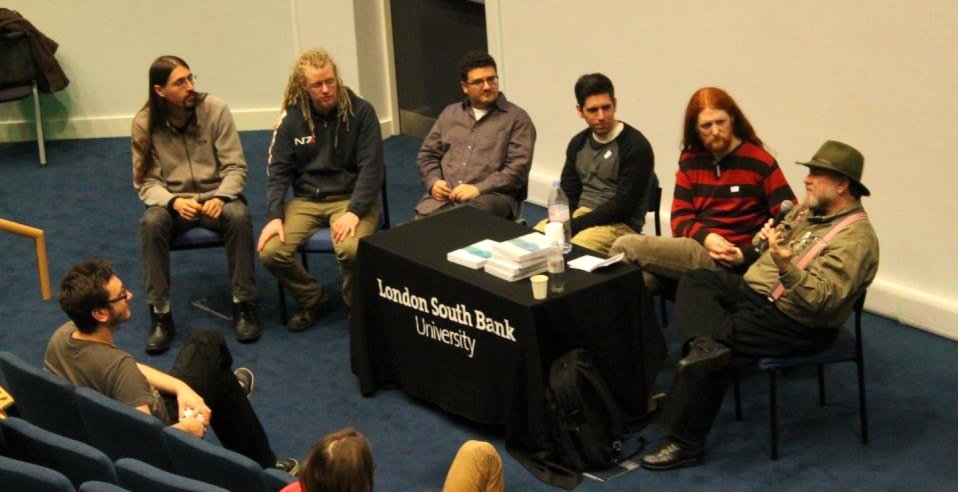
The convention had a Hot Seat area where various gaming luminaries were available at set times for question and answer sessions. There I caught up with Theodor Waern, part of the team behind The Journey Down, and got to ask him about the development of the game and the history of his studio, Skygoblin.
The first two chapters of The Journey Down are now available on a variety of platforms. These currently include PC, Mac, Linux and iOS, though the team is looking at expanding to other platforms. This expansion is somewhat limited by the team only currently containing one programmer, however. They prefer to use the term chapters rather than episodes, as they feel that calling them episodes creates an expectation of the much shorter release cycle of Telltale’s series. Work on the third and final chapter is ongoing, with most of the funding required in place to bring it to fruition.
Way back in August 2010, the first chapter was released as a freeware version using AGS, and is still available for download. Soon after this, the decision was made to turn the game into a commercial proposition using their own engine, Gobby, with much higher graphics quality. At this stage, there were two programmers on the team, Mathias Johansson and Markus Larsson. Markus was more interested in the tech challenges of engine creation so he has since left the team officially, but he is still called in as a freelancer when particular challenges arise.
The first chapter was primarily the brainchild of Waern himself, with the second chapter being much more of a collaborative effort with artist Henrik Englund and the programmers. Theo made clear he was pleased with how well the team works together. All feel comfortable pitching ideas back and forth, knowing they will be respected. This respect also involves being honest with each other about how good or bad ideas are. As a result, bad design decisions that may have slipped through before are now being stopped at an early stage. In a piece of extraordinary timing, they managed to get the game onto Steam just as Greenlight was being launched, which meant not having to get the community approval now required. Achieving this took some smooth talking, however, as there was some expectation from Steam that they would be part of the early stages of implementation for the content approval system.
Skygoblin has actually been in operation for nine years in total, though originally under the name SLX. At first they created mobile projects and advergames, but they were also involved in the creation of Nord, a non-violent MMO that made use of the micro-payment model before it became popular. Unfortunately, they also adopted the model before the technical kinks had been ironed out, with the result that, whilst they had lots of players, they only just covered costs. Even embedding the game into Facebook using Java 3D did not make it take off, and lessons were learned. But now that they’re established with a well-known game, and having a strong and cheery presence at the convention, Skygoblin look here to stay.
Jon Ingold (Hot Seat)
When Jon Ingold’s slot for a Hot Seat question and answer session came up, he eschewed the remote area for the more populated exhibition space, where I managed to catch up with him for a talk about inkle studio.
This has been a good year for inkle, with 80 Days being released to widespread critical acclaim. In making the game, Jon claims there was a desire to give it a rogue-like feel. In such games, knowledge picked up in early playthroughs usually enables the player to progress more easily in repeat plays. In 80 Days, this knowledge includes not only what routes are faster, but where objects can be bought and sold to generate the most funds for the journey. With multiple routes possible, each section of travel allows for different stories to play out. One that has frustrated some players is a journey on an experimental boat on which a murder is committed. Players have a very limited amount of time to investigate the murder, making it quite likely they will fail to solve it. With no facility to rewind the journey, players are forced to leave the matter unresolved, a possibility intended by the developers. Using the rogue-like principles, those wishing to answer the mystery must play through that route again, with the knowledge from their first trip focussing their enquiries a second time round. An expansion covering the North Pole is near to launch, with several thousand additional words added to the text. An Android version should also be released soon.
Inkle have also released Down Among the Dead Men an adaptation of a Choose Your Own Adventure book in which you take on the role of an ordinary seaman, captured and pressed into the service of the cruel and vicious pirate Skarvench. Over the course of the book you escape from Skarvench’s clutches and plot a way to bring the criminal to justice. Although launching later, this predates 80 Days in production and is more limited in its gameplay. Having played through and enjoyed the game myself, I was curious about a reference to fate having saved me two times in my final evaluation. Jon reassured me that there was no element of luck built into the system, the reference being related to the difficulty setting chosen at the start. You can choose whether you live in a cruel, fair or kind world. In a cruel world, the gameplay most closely mirrors the original text, with sudden death being a more common occurrence. In a fair world death is still possible, but only if you’ve done something that really merits it. In a kind world you simply cannot die. The luck reference is simply a measure of how many times you survived when the original text would have killed you.
A few other projects have been produced lately by inkle. The Penguin group commissioned an app to help people learn to recite poems from memory. There has also been an attempt to get well-known authors to write new interactive books. The first of these is available on the app store, Kelley Armstrong’s Cainsville Files, utilising a somewhat different interface than other inkle products. This first foray into getting established authors writing interactive stories has demonstrated that the linear format of a traditional book and the branching of interactive fiction have greater differences than first anticipated. Inkle have also released an anthology of short interactive stories, Future Voices, the winners of a competition making use of the inklewriter engine. Whilst they would love to repeat this endeavour, the time required and the lack of return on the resources invested makes it unlikely they will be able to do so in the near future.
Latest Gaming Articles
All Articles