



AdventureX 2014 – Part 2: The People

Stephen Brown – Followed Freeware
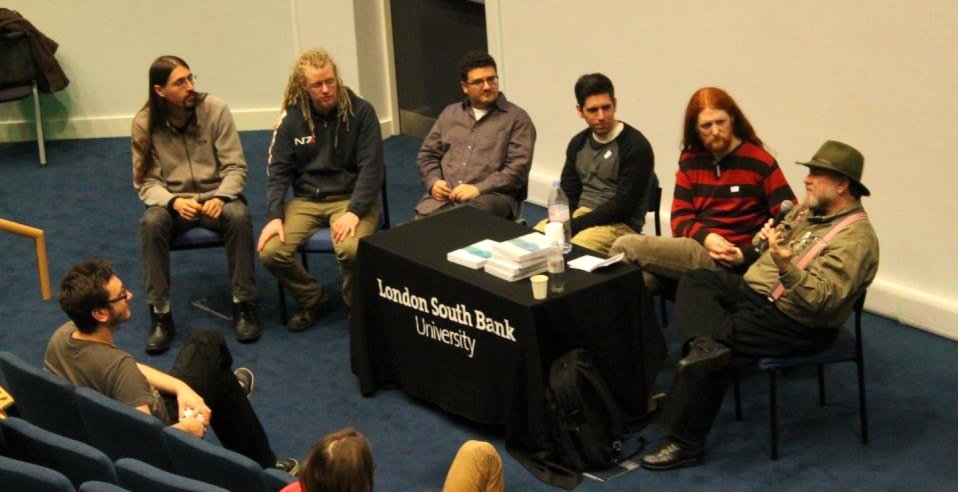
On early Sunday afternoon came the best talk of the convention. A stylishly-clad gentleman strode up to the platform at the front of the room and enthralled a huge crowd. Of course, since that stylishly-clad gentleman was me, it’s possible my recollection of the event may be somewhat biased. What is more certain is that attempting to fit four years of the Following Freeware article series into a 30-minute time slot proved something of a challenge. Having covered well over 400 games in detail, there wasn’t even time to list all of the names. Instead I had to settle for a selection that, in my opinion, best encapsulated the experience of four years on the job. As I took to the stage, and noted the number of freeware developers in the audience, I just had to hope no-one would be upset by any omission.
The resulting talk was very much a whistle-stop tour of the recent freeware scene. Some games referenced came from bizarre concepts, such as Eddie’s Lament, the zombie apocalypse game where every action results in a verse written in the style of Edgar Allen Poe’s “The Raven”. Others were built on clever concepts, like Wages of Darkness, where the titular darkness forces the player to search a pitch black screen. For gamers that complain that time limits are too short, I cited 400 years, which provides you that much game time to complete your quest. I also drew attention to the potential future of gaming on display in Sissy’s Magical Ponycorn Adventure, drawn, voiced and written by then-5-year-old Cassie. (Dave Gilbert later said his daughter Eve would now have to make a game by age 3).
Facts gleaned both during the convention and in the run-up to it also came into play. I was able to explain the reason why Death is the zombie mayor’s assistant in the Reality-on-the-Norm universe: because, in his first ever game The Repossessor, Dave Gilbert made it so. I was also able to share that, from a teaser screenshot posted by Francisco Gonzalez, I knew what the Wadjet Eye Mystery game was ahead of time. Furthermore, I revealed that the planned grand backstory implied by the freeware episodes of Technobabylon was an illusion, James Dearden having confessed to me that he made it up as he went along.
It was an exhausting but satisfying talk to give, and I hope that those who attended thought it was worthwhile. I wonder if I can convince the organisers to let me have a two-day time slot to do it properly next year.
Alexander Birke – Managing Workflows
Alexander Birke’s first experience of game development was Machine Island, which started out as a Danish student project in early 2012. He was also involved in the National Filmschool of Denmark’s Shadow of Kharon, still freely available on the App Store. Now working on the release of Rumpus Animation’s Bertram Fiddle adventures, he has picked up some tricks along the way to make development workflows easier. Illustrated by both stills from his upcoming game and animated demonstrations of his ideas in action, Alexander espoused five principles for making game creation easier.
Firstly, where possible: automate. Brain waves are a precious commodity, so there is no point in wasting them on repetitive tasks. Some activities lend themselves more obviously to automation than others, such as handling the import of content. But Alexander has managed to automate less obvious areas. He has created a utility called Unigayo that allows lip-syncing to be added more easily to Unity-based games. Using this utility to streamline the process, it has become possible to lip-sync 150 lines per day, when 20 to 30 was the previous norm. Secondly, if it cannot be automated, try to make the experience more pleasant. This mainly revolves around using tools to manage in-game activities more easily. Story chain guides and a conversation/timeline tool can give an easy-to-follow structure to the game. Having these run alongside in-game action enables tracking what game process run when, making it easier to see where adjustments need to be made.
Birke’s third point was that file structures should be set up to suit the needs of the team. When there are only a handful of large files, the chances of two people wanting to access the same file simultaneously grow. By dividing files up into smaller chunks, even if they need to be combined into a larger file for the finished game (by an automated process, of course) the odds of conflicts are reduced. Another important principle is accepting that you are going to make mistakes, so you should make finding them easier. The timeline tool Alexander uses really paid dividends in this respect. In the demo he showed, deleting an in-game object caused all the in-game events and interactions in the timeline requiring that object to light up red. This alerts the user immediately of what they have impacted instead of having to go through code line by line and possibly missing connections. Another tool had also been integrated that allowed time to be adjusted, altering the speed that commands were processed, including animations. This made it possible to skip past trouble-free areas, then slow down to examine sections with issues in detail. Finally, and possibly most importantly, good planning pays off. Whilst errors may be inevitable, a bit of thinking ahead should at least cut them down significantly.
Development will never be a simple task, and a lot of work goes into the games that we love. Whilst they won’t solve every issue, the tips highlighted by Alexander Birke should at least make the process a bit easier.
Ali’s Adventurer’s Tavern Quiz
The otherwise sociable convention atmosphere took a more confrontational turn on Sunday afternoon. A group of gamers split into two teams in the main auditorium to take part in a showdown of gaming knowledge. Each team had to select a captain to choose the definitive answer in cases of team dispute. One half of the auditorium elected Francisco Gonzalez, cosplaying as Ben Jordan especially for the event, to lead them. The other half decided to elect yours truly to the role, possibly influenced by my brightly-coloured performing shirt. This was perhaps not the best choice, as I soon found a day and a half of the convention, including a talk on four years of freeware, had wiped all adventure knowledge from my brain. So the stage was set for the epic battle between Team Green Trousers and Team Hawaiian Shirt.
Nelly Cootalot’s Alasdair Beckett-King led proceedings, with his lovely assistant Rachel keeping score. First up were questions on Golden Age classics, of which Francisco proved a powerhouse of knowledge. Then came Pixel Hunt!, a free-for-all round in which small parts of adventure gaming scenes were shown with players from both sides shouting out where they came from. Identifying King’s Quest 1 from barely a dozen pixels, Team Green Trousers leapt ahead. To complement the Golden Age round, 21st Century(ish) Adventures made up the third round (the ish referring to the fact that some came out in 1999). Another free-for-all round of Mystery Music followed, with short and long samples of the same tunes being played. Though guesses weren’t readily forthcoming for the single-second samples, the complete versions proved more recognisable. My brain sparked temporarily into action on this one, identifying the 11th Hour theme after throwing out a series of almost correct answers in quick succession. Indie gems followed and then we had the Odd-One-Out round. This included characters who had died and come back, and characters with common modes of transport. Behind the Scenes, addressing games production, was the penultimate round, Team Hawaiian Shirt scrabbling for extra points any way we could justify them. A last free-for-all round, Christmas Rebuses, topped off the fun with mash-ups of adventure game scenes and characters created to represent Christmas songs.
I’d like to say Team Hawaiian Shirt won the day. Alas, even the close second of our final score was probably more down to the generosity of the other team in allowing shaky answers to get points. Regardless, the quiz made for good, slightly anarchic, fun. The questions themselves covered a nice variety of gaming knowledge, and Alasdair did a good job of wrangling a bunch of unruly adventure fans to see it through with his trademark light humour. Limited edition Nelly Cootalot doubloons (a batch created for the Kickstarter that had been made with the engraving erroneously created as a negative image) were handed out to all as prizes for taking part. As a special bonus, having lent my reporting notepad to the scorer, I also gained an exclusive original artwork, though this painfully appears alongside proof of my team’s defeat.
Latest Gaming Articles
All Articles