



Laney Berry – The St Christopher’s School Lockdown

[b]Ingmar[/b]: What comes to mind when you remember your own days as a student, and how much of what you’ve seen personally made its way into the script?
[b]Laney[/b]: To give you an idea of how much my own experiences as a student are tied to this project, I’ll let you know that I had (co-creator) Alejandra (Rojas) design St. Christopher’s based on photographs of the exact second-form college I attended in Egham, Strode’s College.
I won’t lie to you; I was a bit of a handful as a teenager. I was always looking for excitement, and even borderline dangerous situations. So while I won’t go into a lot of detail, I’ll say that I have seen my fair share of completely obliterated households after raging parties, I’ve had to call emergency services to have friends taken to the hospital with alcohol poisoning, I’ve even been chased by bouncers out of a strip club in Soho… In other words, I was a stupid kid who thought she was indestructible and “cool”, but really I was just a pain in my parents’ ass. That’s the kind of angle I write from when I’m constructing my characters. They’re young. They’re reckless. They haven’t fully figured out their own identities, so they are experimenting with life as much as they can and seeing where that takes them (spoiler: not far). For a lot of these characters, this is a coming-of-age, and the events they go through within the game will be a MAJOR reality check for them. Sometimes, the real lesson is, you just need to get over yourself and grow the hell up!
I’m sure several personal anecdotes will manage to make their way into the game. I know a few already have. Certain characters definitely have bits of my own teenage self in them, and others are based on people I knew back then, or younger versions of people I know now.
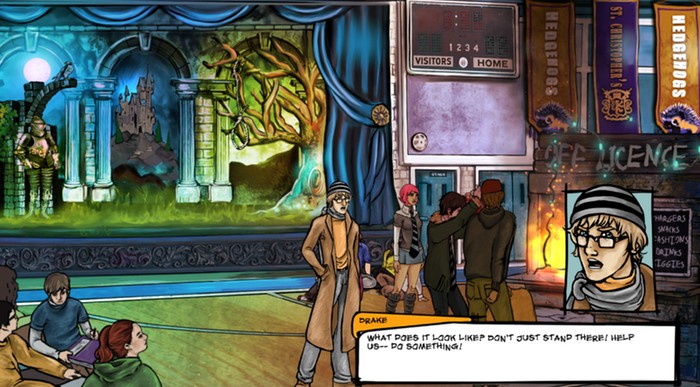
Despite the age of the characters, however, this won’t be a game for kids, just like Lord of the Flies was not a book for children.
Laney’s real-world alma mater, Strode’s College
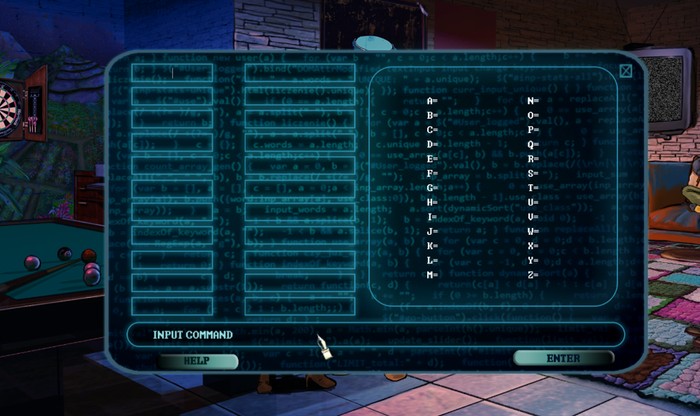
In-game depiction of fictional St. Christopher’s
[b]Ingmar[/b]: St. Chris has been on your mind for many years now, and I bet lots of things have changed throughout the years. Can you give us an idea of certain aspects you originally wanted to do differently before you came up with the current design?
[b]Laney[/b]: Well, for starters, St. Christopher’s was originally going to be a graphic novel, not a video game at all! As a game, this concept has gone through a ridiculous amount of revisions, too. Just for starters, Roger Spencer was going to be the ONLY playable character – now he’s been relegated to an NPC. Sorry, Rog! There are characters who I had originally conceived of as major figures who have been cut out entirely, ideas for scenarios which didn’t eventually fit the tone of the game, discussion on just HOW much of a glimpse the player will get into the outside world beyond the school grounds, etc. And let’s not forget how many name changes this project has gone through – even now we’re just at a working title, but we’re still not entirely sure it’s snappy enough. First world problems, huh?
Even as far as the genre itself, while I always wanted it to be an adventure game, we discussed potentially including combat, developing it as more of a visual novel (in the style of Hotel Dusk), and even, at one point, Alejandra attempted to get me to turn it into an interactive, branching graphic novel. The latter two would most certainly have been less ambitious, but I decided that, with this game, I had to go with my gut, and it’s always felt like a traditional point-and-click adventure game to me, and one which would NEED the kind of complexity I am aiming for, if I wanted to do it justice.
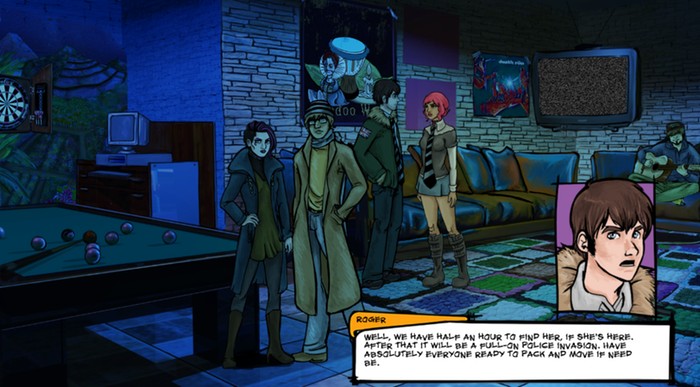
An earlier Spanish version of St. Christopher’s was tentatively titled “Molotov” for a grant application in Chile
[b]Ingmar[/b]: Your Kickstarter campaign is strictly focusing on a public demo and the first episode for the moment (unless you reach your stretch goals). What can you tease about the particular content of Episode One?
[b]Laney[/b]: Well, I can certainly inform you that, in Episode One, you will be thrown right into the center of the protest with very little warning! However, you will be playing as the character of Kayleigh, and she is NOT a St. Christopher’s student; she doesn’t know ANYBODY within the school. This is intentional – you will be playing from a fresh perspective, and will be meeting all of these characters for the first time, through her eyes. I believe this will offer a very natural introduction to the various key players within the storyline, as she is discovering everything at the same time as the player does, which would not have been the case if we’d started the series with a character such as Drake or Hash, who are already quite integrated into the various happenings.
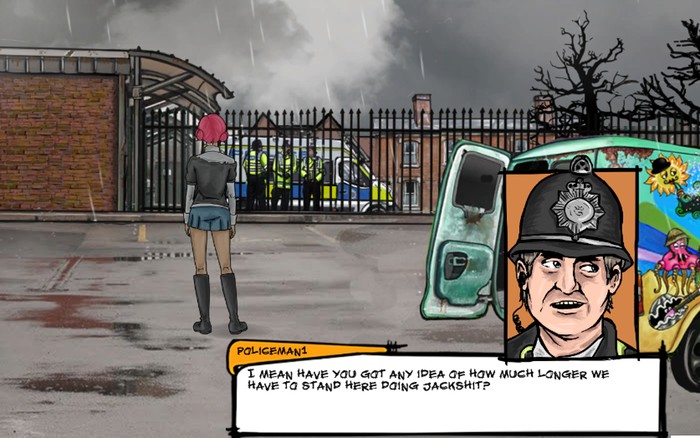
Kayleigh is a very interesting character to me. She suffers from bipolar disorder, and as soon as we meet her, we find out she’s on the run from a character only referred to as “Jono”. As we progress through her episode, she takes refuge within the lock-in, and conceals her true identity from everybody, simply pretending that she’s always been a St. Christopher’s student. It’s all very suspicious, and it’s also intentionally ambiguous. I love playing with this idea of the unreliable narrator, and the relationship between the player and the playable character has always been one which I’ve found fascinating, in terms of the disconnect between what the player knows, and what the character knows – just look at how wonderfully that played out in Heavy Rain. We hope to do similar things in St. Chris as a whole, and Episode One is where you’ll start to get a glimpse into that.
I don’t want to reveal too much more, but aside from dealing with an unmedicated case of bipolar disorder, you will also need to raise quite a large sum of money in quite a short time… Why? Another of Kayleigh’s secrets.
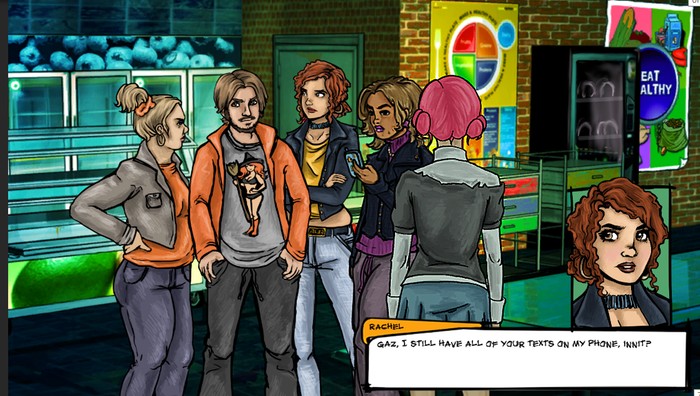
Character concepts of Kayleigh, the first playable character, and Shilling, who was inspired by Gavroche from Les Misérables
[b]Ingmar[/b]: Apparently there will be certain roleplaying elements, including stats, reputation and a morality gauge. Can you explain how these elements work in the game? In addition, you recently told me how much you adore the Coles. Was Quest for Glory the inspiration for the roleplaying?
[b]Laney[/b]: Can I just state for the record that Quest For Glory is my favorite game series of all time? And this is despite the fact that it’s so very, very different to the kind of game I’m aiming to make – perhaps because I know that QFG did it so damn well that there’s just no point in trying to emulate it!
However, oddly, I think the roleplaying aspect comes less from Quest for Glory and more from titles such as Vampire the Masquerade: Bloodlines, where things such as your skills in terms of charisma, persuasion, computer hacking skill, etc., have certain values which you can actively work toward raising, and one can’t help but prioritize some over others to help fit your gaming style. Now, of course, Quest for Glory has all of this, but I find that so many of the stats in it are rather combat-focused (Strength, Stamina and Parrying, for instance) or class-centric (Lockpicking and Magic), rather than elements defining a character’s personality, or skills that they can pick up later in the game.
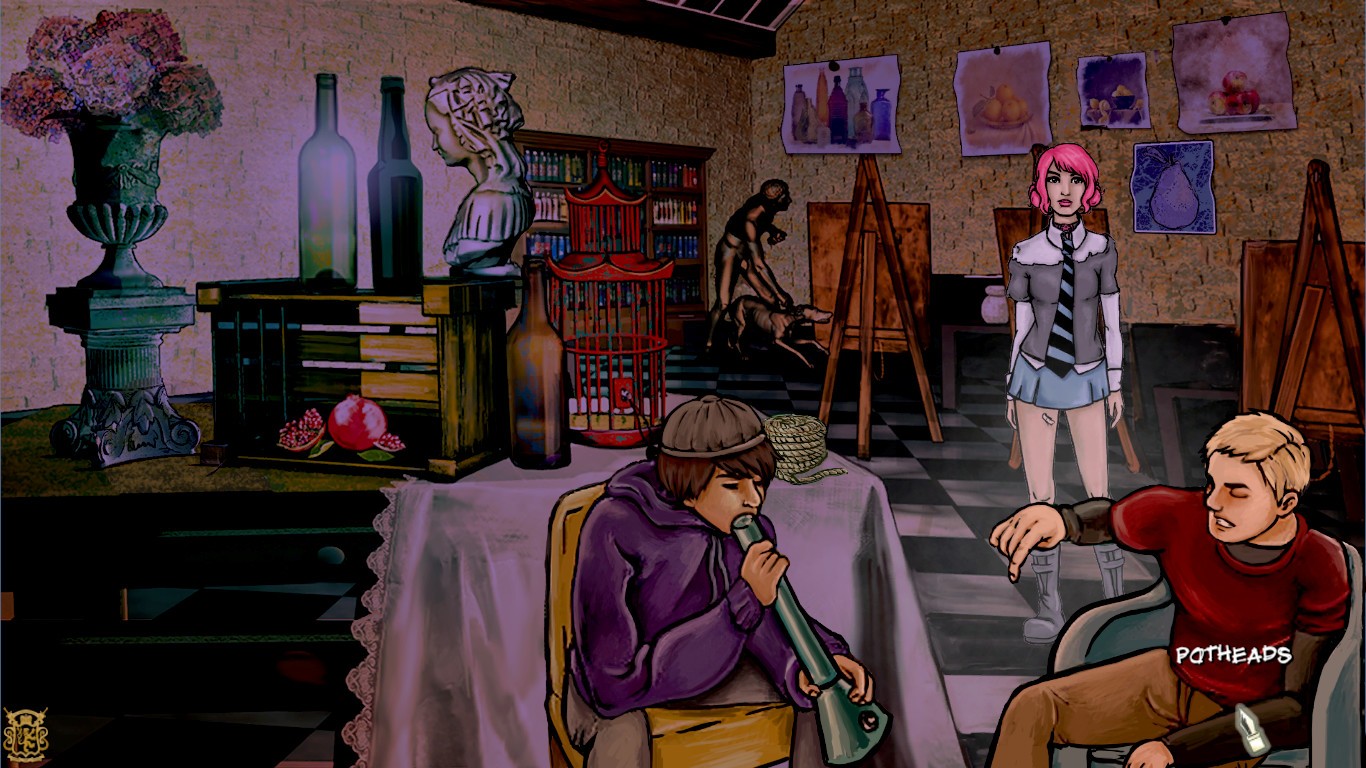
I think statistics are highly underused in adventure games – they are an ideal way to add variety to puzzles, instead of just repetitive item-combining and unlocking doors. Let’s say you’re trying to get some dirt on another character. With enough points in Charisma, you could charm somebody into telling you their secrets. With a high enough value in Hacking, you could get it off of someone’s private e-mail account. With Intimidation, you could simply bully them into giving it to you directly. You get the idea. Why has this always been a system reserved mostly for combat-oriented, open-world titles, when it would work just as well in a point-and-click adventure? The Coles were definitely on to something with this, and we’re looking forward to experimenting with this approach.
There will be a variety of different gameplay elements in St. Christopher’s
[b]Ingmar[/b]: Some of our readers might want to lynch for me saying this, but I’ve gotten pretty tired of old-school adventure game mechanics like tons of inventory puzzles, fetch quests, etc. that often distract from the story progression and ruin the immersion. St. Chris seems to be a very different case where you try to turn story AND gameplay into one organic system. How exactly do you plan to achieve this?
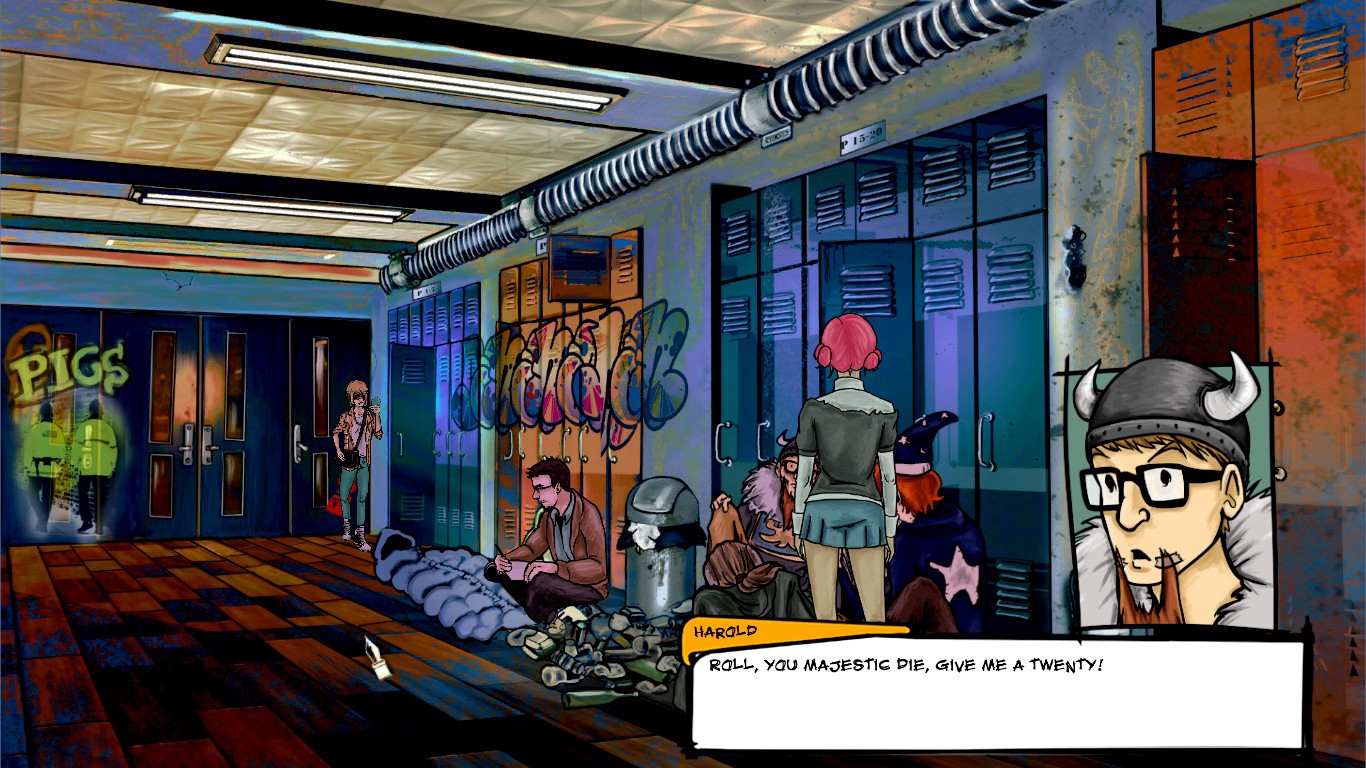
[b]Laney[/b]: We’ve all encountered enough locked door/find-the-key puzzles in previous game experiences to get too excited when we face a new one. One way in which this game avoids these sorts of pointless quests is by sheer luck: these kids are in a survival situation where resource management comes down to its most basic level. The police have fenced the kids inside the school, so coming and going is very restricted, and when done, very difficult. Getting a fleece-lined jacket from a locker becomes much more meaningful when the electricity has been cut off and you’re close to hypothermia in the middle of an icy British winter. To have to give someone a chocolate bar in exchange for a password makes much more sense if the characters have been surviving on moldy pizza leftovers for the last three days. While this is not a survival game, the local economics force a certain level of resourcefulness which demands creative solutions for very real and reasonable challenges, which become interweaved with the narrative. We learnt a lot from The Walking Dead in this respect, and while our game doesn’t have the urgency of a zombie apocalypse, these kids are still trapped between a rock and a hard place.
In this game, every chapter also contains something of a mystery which needs to be solved. Mystery doesn’t always have to involve the typical “Who killed Mr. Boddy?” scenario, and curiosity is not always directed at major issues. Believe me, the identity of an unfaithful husband’s lover can have people guessing for multiple seasons on a well-written soap opera (is that an oxymoron?). Fact is, as humans we need to know that which is not revealed to us. For example, we hope our player will get emotionally invested in keeping the playable character of Shilling away from child services. The poor kid has a hopelessly dysfunctional mother whom he protects with all the limited resources of a twelve-year-old, but the progression of events during the game puts him in serious risk of being sent into foster care. The player can do lots of things to influence this subplot, and this generates lots of gameplay, which becomes inseparable from the narrative.
There is, of course, also the overarching political struggle within the school, and we hope that the player will become invested enough to find that helping either Roger or Martin to achieve their goals is satisfying enough to keep pushing them forward.
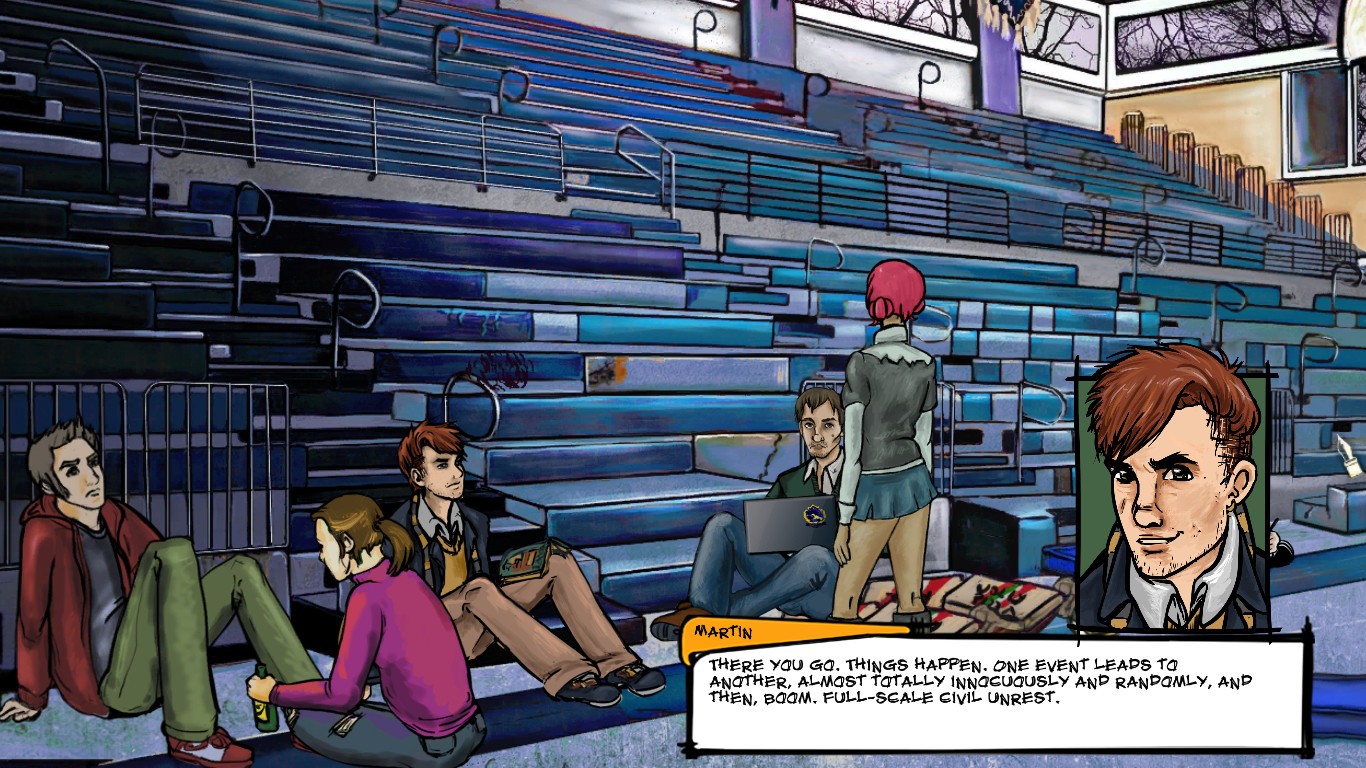
And finally, let’s not forget that these are kids confined for about three weeks in a school which doesn’t even have beds, so of course they have to create their own entertainment. They play drunken darts, they have mini-battles with their collectible tradeable voodoo dolls, and later, when the electricity has been cut off, they play charades in the dark, and as a player you have to direct your flashlight at the action to see what movie or celebrity your team is trying to mimic. While the game is mature and, we hope, intense from the emotional point of view, there is still harmless fun to be had.
Latest Gaming Articles
All Articles