




Until 9:15 a.m.


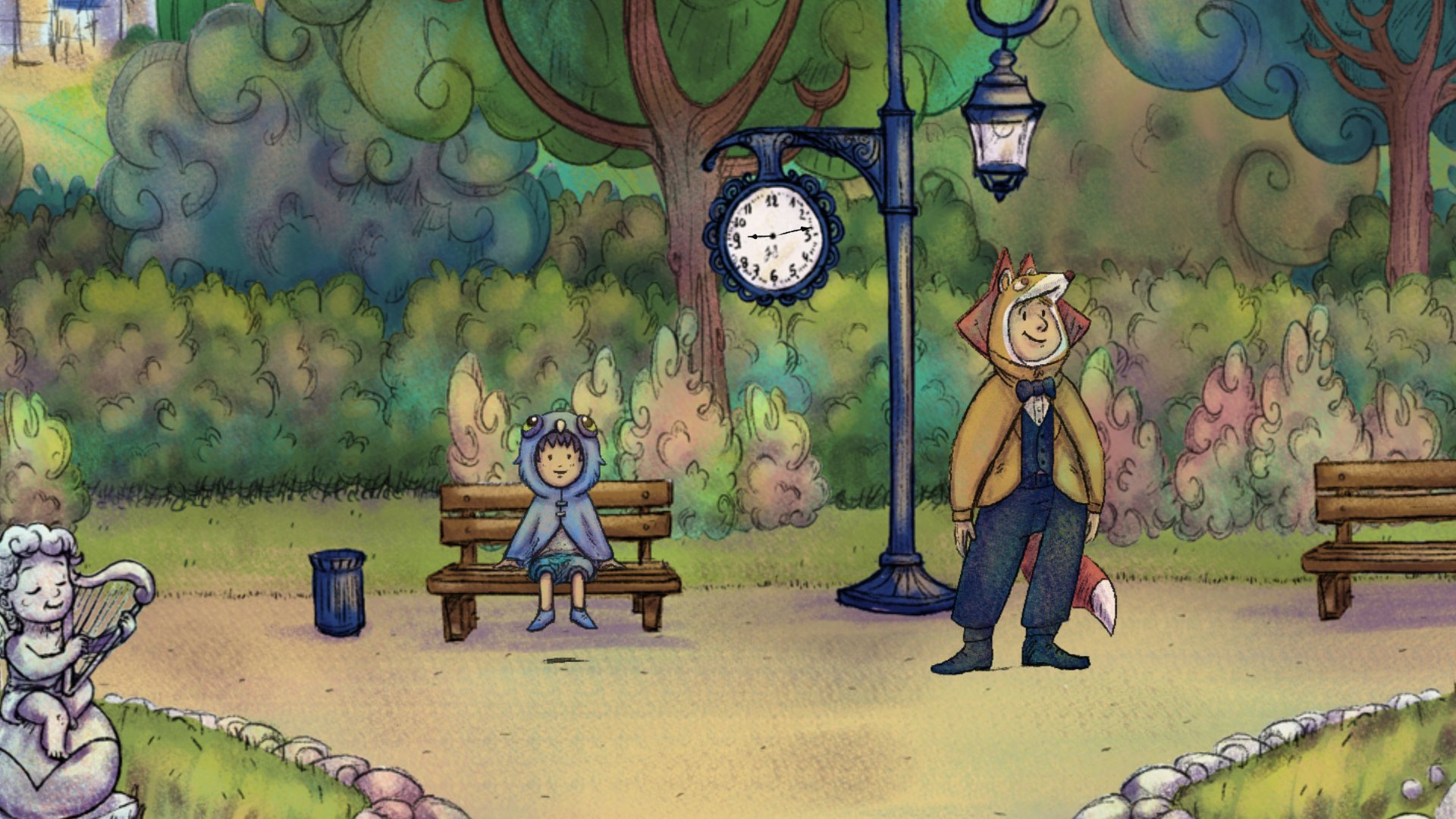
A young girl dressed in a blue hood and cape resembling an owl sits on a park bench, waiting for the time to tick from 9:14 to 9:15. A loitering gentleman attired in fox hood and tail suggests to her that she may need to help it advance by fixing the town clock on a hill in the distant background. And so begins the short but charming tale of ObeQaen’s Until 9:15 a.m. The world isn’t in danger. There’s no evil foe to vanquish. It’s just a little story of an owl girl on her quest through beautifully hand-painted environments, which is delightfully charming in its simplicity.
As the young protagonist makes her way out of the park, through town, and ultimately to the inoperative clock tower, she’ll meet a number of eccentric other animal-costume-clad individuals whom she can help or seek help from in various ways. Mechanically it plays out like a standard a 2D point-and-click game for the most part. Gameplay comes from exploring your surroundings, accumulating inventory items along the way, which are displayed at the bottom of the screen by clicking on a small cloth pocket.
The puzzles too are fairly straightforward, lacking in moon logic and not requiring an inordinate amount of brain-bending to solve. The one novelty, however, is that in addition to collecting physical items, the owl girl (who remains nameless throughout the game) can also add words to her inventory. When she observes a statue holding a harp, she may not be able to wrest the instrument from its grasp, but she can add the idea of a “Harp” to her possessions. When she sees a street lamp in town and then another, she’ll obtain the word “Again.” Intriguingly, some words can even be combined to create short poetical phrases, which just so happens to be exactly what the town gardener, wearing a bird suit, needs for inspiration to create imaginative topiaries in various parts of town.
Other characters have their own needs. The owl girl takes a shine to those she meets and often seeks to help them. There’s a shy woman dressed as a white wolf who needs a friend. A young child in a mouse costume wants nothing more than for dresses to come back into fashion. A down-on-his-luck labourer with a dog hood is desperate to find a job. And a talking tree seeks to be carved into a real puppet so that it can dance. Over the course of the game’s two-hour play time, you will have the opportunity to assist each of these characters, often receiving some sort of benefit in return as you make your way closer to the tower’s malfunctioning clock.
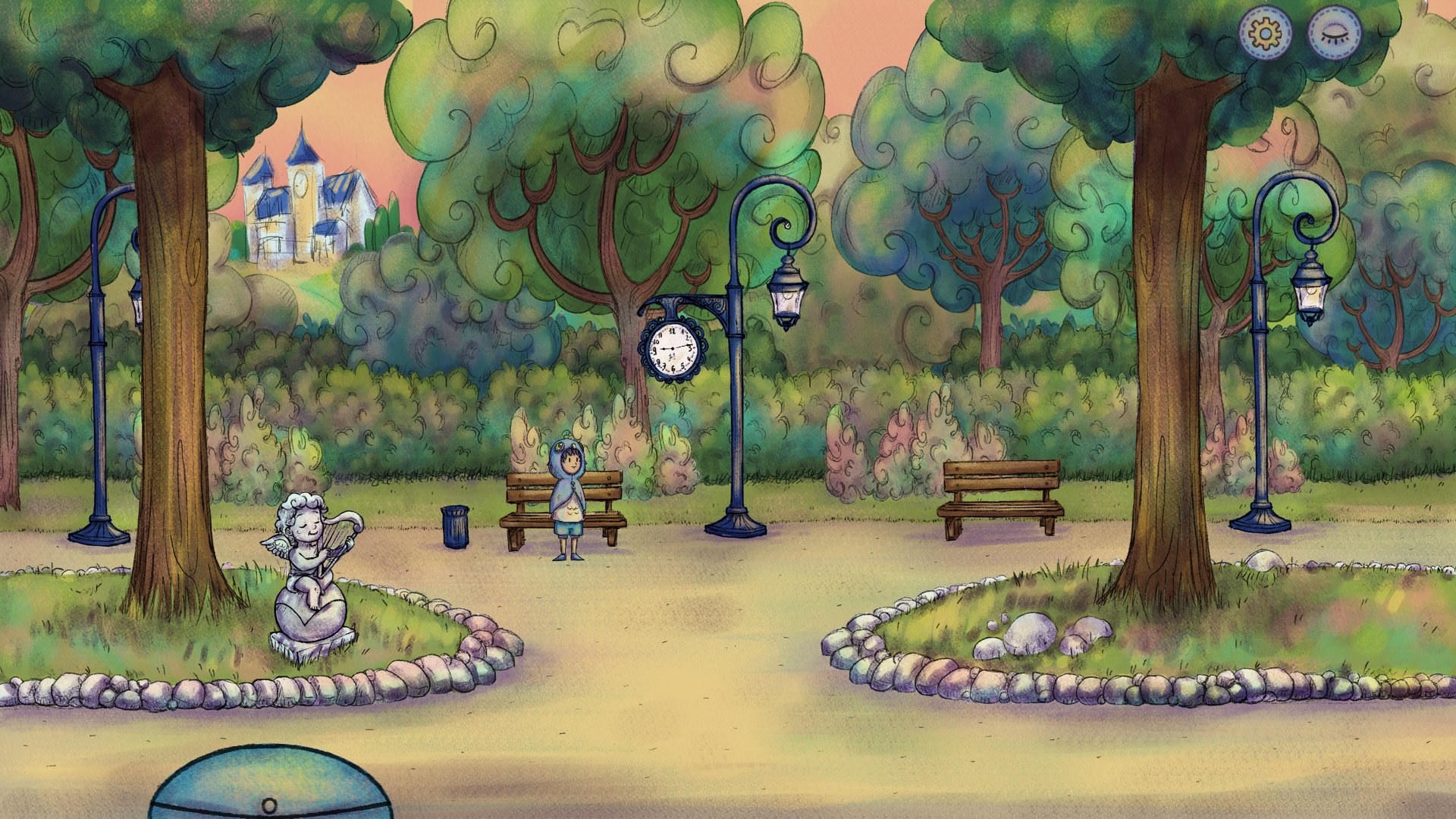
The journey leads you through a park of meandering paths with trees and bushes waiting to be sculpted by the gardener, and a small playground that has seen little recent use. A vaguely European town waits nearby with tall houses, arched bridges and a stately manor that serves as your ultimate destination. These locales are linked together in such a way as to make it quick and easy to get from one to another. For those who don’t like to dawdle, double-clicking on any exit causes the scene to fade out and the next to immediately display.
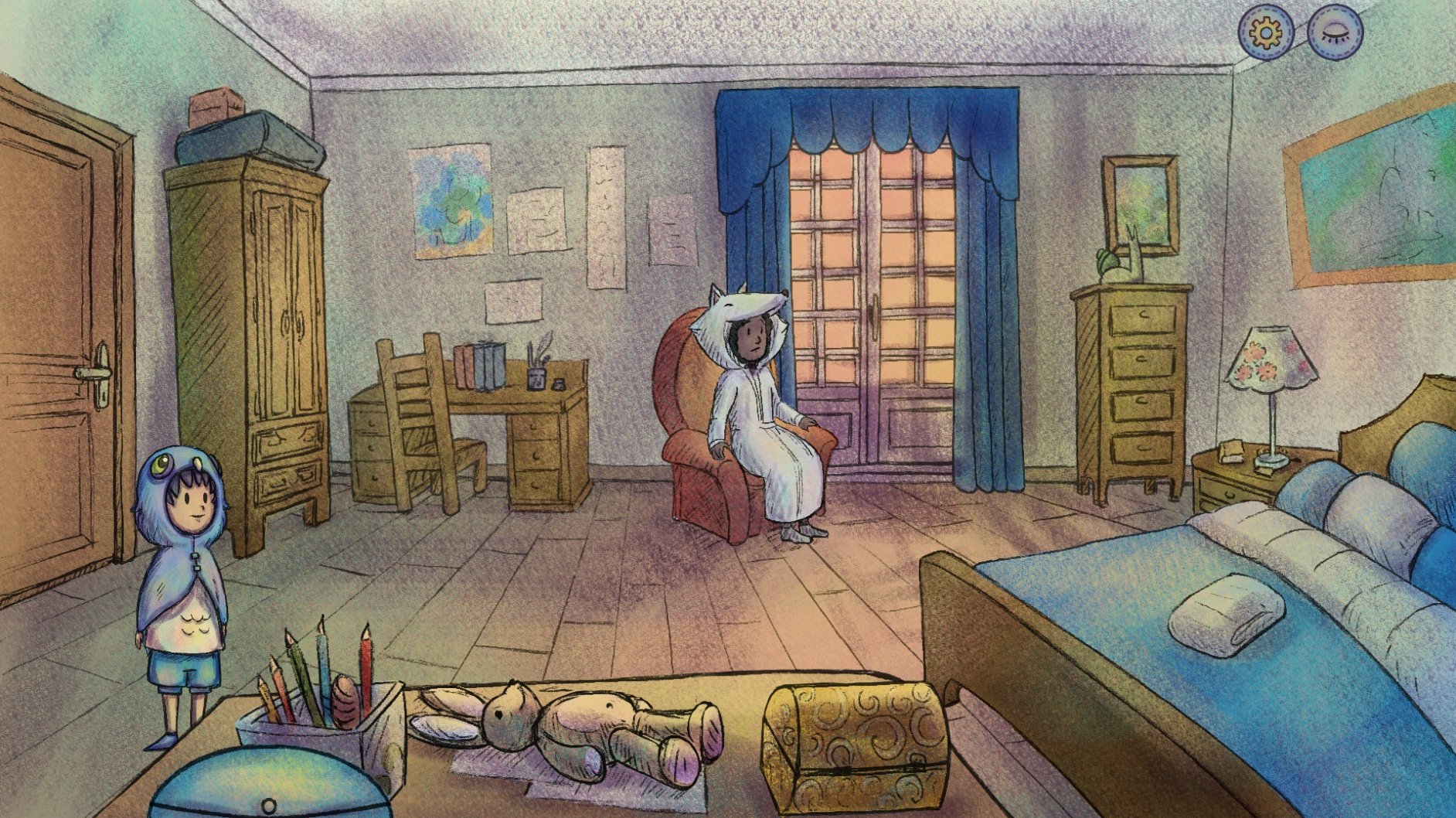
All of these backdrops are depicted in a pleasing, distinctive art style that resembles pencil sketches on canvas that have been beautifully colourized with pastel hues. A similar aesthetic applies to the cutely drawn characters who blend in naturally with the scenery, though they have very little animation to speak of.
Also fitting in well are the various hotspots that can be interacted with. Sometimes they fit in too well. I occasionally ran into difficulties where I thought that something that should obviously be a hotspot was not, and vice versa. Fortunately in the game’s settings is an “Interaction indicator” option that is turned off by default. When activated, however, an eye icon is displayed in the top corner of the play screen. Clicking this highlights all of the hotspots in the current scene, which remain until the icon is clicked again.
The available settings are remarkably robust for such a short game. Among the usual features are options for tweaking the dialog display including font, color, and whether small portraits appear during conversation. There’s even an inventory setting that lets you choose between drag-and-drop or clicking an item to turn it into the active mouse pointer for use in the environment. The game also boasts four manual save game slots in addition to its progressive checkpoint system for recording your progress. The customizability makes for some nice added value that isn’t often seen even in much bigger productions.
Your journey through these peaceful, almost dreamlike locales is fittingly accompanied by a gentle musical score. Comprised of simple strings, piano, and harp sounds, it’s a comforting backdrop that reinforces the relaxed, laid-back atmosphere that befits a town where time practically stands still and its inhabitants wear unremarked-upon animal costumes. Sound effects are sparse, however, consisting mostly of the clicking that coincides with dialog appearing tickertape-style during conversation, or the store bell ding that goes with collecting a new inventory item.
None of the characters are voiced but the text has been localized to English from its original French. (Though it’s being sold under its French title En attendant 9h15 there is an English-language option in the main menu when starting.) For the most part the translation is fine, though there is the occasional stilted line of dialog. There are also a few cases where it impacts gameplay. For instance, at one point the owl girl gets the inventory word “barrelhead.” In English, this refers to the flat pieces at the top or bottom of a barrel. After trying to figure out what to use this on and getting some odd responses, I finally deduced that the game was referring to it more along the lines of the term “piggybank.” It’s awkward whenever you have a puzzle piece you can’t identify, but even more so when you have one that you think is something else entirely. Some of these led to the old standby of trying everything on everything, but because the game has relatively few scenes and hotspots, even this “solution” is not too burdensome.
Eventually the owl girl succeeds in finding someone she believes can help her fix the clock. Ultimately the ending is rather clichéd, and specifically the kind of cliché I usually can’t abide, but in this particular case it is handled so well and is so in sync with the whimsical, semi-surreal tone of the journey to that point that I ended up feeling very satisfied with how the young heroine’s tale was resolved.
While most adventure games are fairly leisurely, Until 9:15 a.m. differentiates itself even further by being a nicely low-key little tale. There are no world-ending calamities to avert, no ancient mysteries to uncover, no murders to investigate or anything from the other common narrative wells adventure developers regularly dip into. Instead, it’s a sweet story of helping others as you wander through a dreamy landscape of pastel colours and calming music for a couple of relaxing, uplifting hours. As a lightweight almost-fairy-tale, this is the perfect game to play when you’ve got some time to fill between heavier, more serious genre fare.

The Good
- Pleasant, relaxing atmosphere
- concepts as combinable inventory items is novel
- beautiful hand-painted pastel backgrounds
- cute character designs.

The Bad
- Some difficulty differentiating hotspots
- a few localization issues
- ending a bit clichéd.


A game of very high quality. Although some aspects might have been executed better, we would recommend this game without hesitation.
Waiting for a minute to pass has never been such whimsical fun as in the gorgeously serene Until 9:15 a.m..


Top Adventure Games
More