



Puzzling (Mis)adventures: Volume 4 – Crayon Physics Deluxe, Your Doodles Are Bugged!

Remember back when you had to solve puzzles using – gasp! – words? Once upon a time, we actually had to type answers in, before developers took pity on us and narrowed our options down to select group of verbs. But in this day of texting and IM, who has time even for that? And so we moved to point-and-click (or P&C for the “tl;dr” crowd), which streamlined things further still with a one-click-fits-all mentality. And hey, we’re not knocking it! Fussing over interfaces to perform basic actions is no fun at all. And yet, it does create a rather wistful longing for the days when our input actually mattered.
While adventure games often still follow the KISS interface rule, puzzle games outside the genre are beginning to broaden their horizons once again. One of the better attempts to revive interactive player participation, Scribblenauts was a creative mix of emergent gameplay and childlike graphics, but it was still limited by a pesky text parser. So why not just cut out the middle man and let us design solutions ourselves? In our ongoing pursuit of quality puzzling wherever it may be found, today we explore two games that allow us to do just that. Crayon Physics Deluxe and Your Doodles Are Bugged! present different kinds of challenges, but their approaches have one thing in common: artistic problem solving. Now that’s what we call drawing your own conclusions!
Crayon Physics Deluxe
Dante Kleinberg
How many ways could you find to solve a puzzle if you could draw any shape you pleased? In Kloonigames’s Crayon Physics Deluxe, you’re presented with a ball, and you need to get that ball past various obstacles until it touches a star. Whether you do this by drawing a bridge, a swinging club, or a makeshift catapult is entirely up to you. When you first launch this unique game, it explicitly states its thesis: “It’s not about finding just any solution; it’s about finding the awesomest one.” How you feel about that statement will ultimately dictate how you feel about the game. Are you perfectly happy making your own fun with a virtual toybox? Or do you expect a video game to provide at least some of the fun for you? If you lean towards the latter, as I do, you may initially find Crayon Physics Deluxe an exciting concept and exercise in creativity, but one that ultimately becomes tedious before finishing its 70-plus levels.
Though Crayon Physics Deluxe is available for iOS platforms, and compatible with a Tablet PC (I suspect a tablet with a stylus is probably the most satisfying way to play it), this review is based on the standard PC version. Playing the game this way is as simple as using Microsoft Paint: you left-click and hold the mouse, and you draw. Draw a square in the middle of the screen and it falls to the ground, as everything is subject to the standard laws of physics. Draw a circle (if you can manage it with a mouse; I couldn’t) and it will roll when propelled. If you don’t like your creation, simply right-click on an object you’ve designed to erase it. This seems freeing but is ultimately very limited, as only basic shapes are effective. You could try to draw a helicopter or a dragon, but all you’ve really accomplished is a fancy block.
Early on, the obstacles are fairly straightforward, as you’ll simply need to guide your ball across chasms or up and down slopes. But as the game progresses, the challenges increase and a few other tools are given to overcome them. A tiny circle can become a pin that is fixed in space. You can draw a plank or a club around the pin, and it will swing due to gravity. You could similarly use two pins to make a free-floating platform. Some later levels include rockets, which can be tied to other objects and launched, though unlike pins, you can’t make your own. There are ample tutorial levels along the way, so the new tools never feel overwhelming. If you get desperate for a way to propel the ball, you can simply click on it to nudge it in either direction, but there are penalties associated with doing so, which is where the flag system comes in.
You can get up to three flags per level, and netting all three gives you a bonus star (the more stars you have, the more levels you unlock). The first flag is given for an Elegant Solution, where you draw only one object (pins don’t count) and don’t click the ball. The second flag is given for an Old School Solution, where you can’t click the ball, use pins, or draw something under the ball. The final flag is the Awesome Solution, which is surprisingly determined completely via the honor system. Do you think your solution was awesome? Then you can award yourself the flag. Uhh… Congratulations? Rube Goldberg-aficionados notwithstanding, it’s hard to resist the temptation to simply devise a few techniques that reliably move the ball where you want it to go, then utilize these solutions for every puzzle. Because there are no “right” answers, it’s hard to say if the game is easy or difficult. Easy enough to get the ball to the star, if that’s all you want, but if your goal is to earn all three flags for every level, the challenge level can be truly devious.
If 70-plus levels aren’t enough for you, there are something like 7,000 user levels available to download from the Playground, either in-game or from the Crayon Physics Deluxe website. I can charitably say the user levels vary in quality. Unfortunately, the system for sorting through the levels is less than perfect, as trying to view only the levels with the best player reviews gives you many, many entries with exactly one five-star rating. The level creation system is well-made if you’re into that sort of thing, which I admittedly am not. Draw whatever you please—a hill, a bumpy road, or even that helicopter or dragon—then pin it in place, position the ball, add a star or twelve, and you can call yourself a level designer. You probably won’t go on to fame and fortune, but some levels have been downloaded in the low thousands.
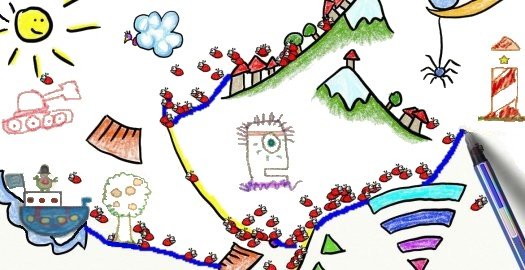
If you ever bought a jumbo box of 64 crayons as a child, you can’t help but be charmed by the way Crayon Physics Deluxe looks. Absolutely every line, whether depicting the sun, puffy clouds, fruit trees or lighthouses, is identifiably crayon-like. Even the level-select map screen and tutorial animations look like childlike hand-drawn designs against a backdrop of slightly crumpled paper. When adding your own creations, you can cycle colors using the mouse scrollwheel. You can even draw outside the lines on the map (designed to resemble a sea filled with “islands” of levels to visit in your boat) to your heart’s content. The background music is a pleasant, non-intrusive melody that neither interferes nor illuminates, and could easily be replaced with your own soundtrack if you were so inclined.
Crayon Physics Deluxe gives you the ability to draw any shape you can imagine, but doesn’t require it from you, or even particularly reward you for it. Do you take pleasure in drawing for its own sake? (Though even if you do, have you ever tried drawing with a mouse—it is not easy!) Do you have a strict, personal definition of “Awesome” you enjoy struggling to meet? Really, how much effort above the bare minimum are you willing to put in if no one will ever know and it has absolutely no consequence on your life? Before you decide whether or not to purchase this game, you should know the answer to this question, or at least download the demo to discover the answer for yourself. Though undeniably charming and inventive, ultimately this is a game that is only as fun as you make it.
Next up: Your Doodles Are Bugged!…
Latest Gaming Articles
All Articles