



Moebius hands-on


Without a doubt, Moebius feels like a Jane Jensen game. From the opening sequence to the game’s nearly-obsessive attention to historical detail, this game is unquestionably a return to form for one of the adventure genre’s pioneers. At E3, I had an opportunity to sit down with Jane herself for a preview of the preliminary build that was about to be released to the supporters of her Kickstarter campaign. It was a rare chance to hear the design philosophy behind the game, which, when it is finally released later this year will be the first from Jane’s Pinkerton Road Studios.
Moebius certainly has a lot of pressure on it. In addition to being the first “real Jane Jensen” adventure in 13 years – while she wouldn’t say it directly, it’s clear that at least some of the failings of 2010’s Gray Matter resulted from the lack of Jane’s full creative control – it will also be one of the first high-profile Kickstarted adventures to be released. The question that kept running through my head throughout the presentation and my own later playthrough of the first two chapters was whether Moebius was going to be too old school for today’s gaming audience – would Jane be able to innovate in a medium that has advanced considerably since cat moustaches? (And yes, I know that wasn’t one of Jane’s own puzzles.) That’s a question that won’t be answered until the final game is released, as I found my early exposure raised more questions than it answered, though from what I did see Moebius looks incredibly promising,.
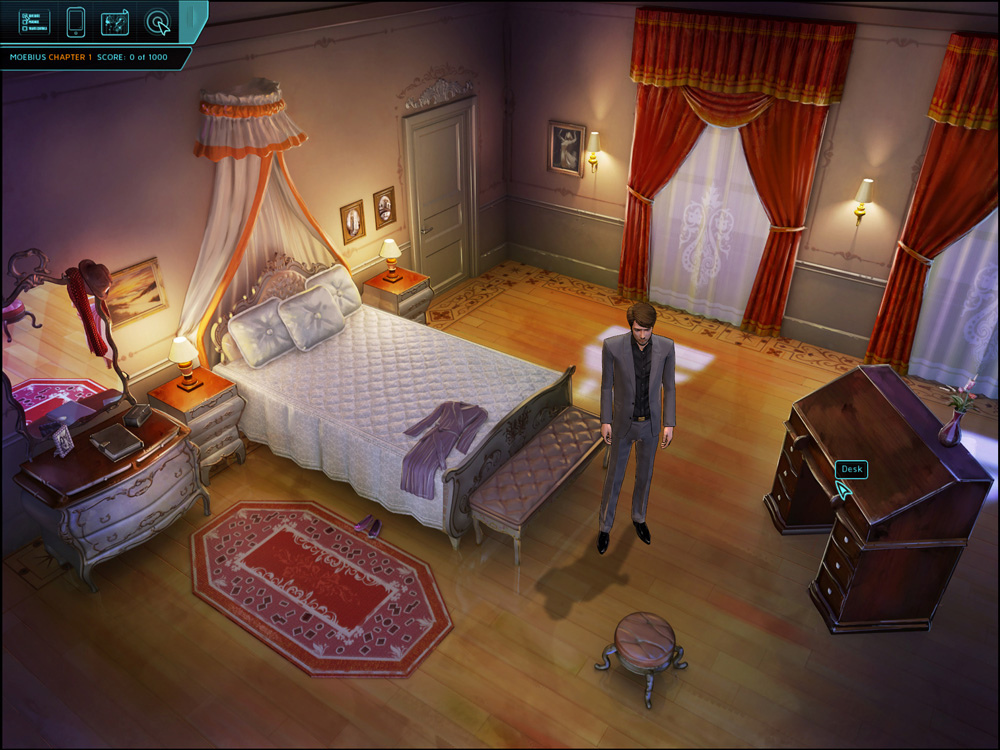
Similar to Jane’s Gabriel Knight series, Moebius is a paranormal thriller which stars a very unusual protagonist. Malachi Rector is the newest hero, and while he may not be a chosen schattenjager, he certainly possesses a number of traits that set him apart from his fellow man. Players are treated to an electronic comic at the start of the game which provides Malachi’s backstory: in a nutshell, he’s an uber-genius with an IQ north of 175 with a fractured and difficult family history. In addition to his smarts, he possesses a photographic memory and the ability to quickly measure up situations and people – often analyzing them against the limitless database in his cranium. He’s a modern day Sherlock, who also happens to pop Xanax pills like Skittles.
Watching the opening to Moebius, I was struck by the obvious similarities to Sins of the Fathers. After the e-comic which introduces Malachi, we have an opportunity to get a little acquainted with his home base. While he’s in New York City instead of New Orleans, Malachi’s antique shop is eerily similar to Gabriel’s bookstore. And Malachi’s cheeky female assistant Gretchen could be a body double for Grace Nakimura. The fact that Malachi also has a tiny office off his main shop is another detail that provided a sense of deep déjà vu.
The way the gameplay begins is also in the classic Sierra adventure style. Moebius is played in third-person perspective, and players will point-and-click to send Malachi to different locations, inspect and interact with objects within each location, and open up dialogues with the game’s cast of characters. Unlike Gabriel, however, Malachi isn’t a simple salesman at the start of the game – he hires his memory and deductive abilities out to bidders who wish to determine the authenticity of historical antiquities.
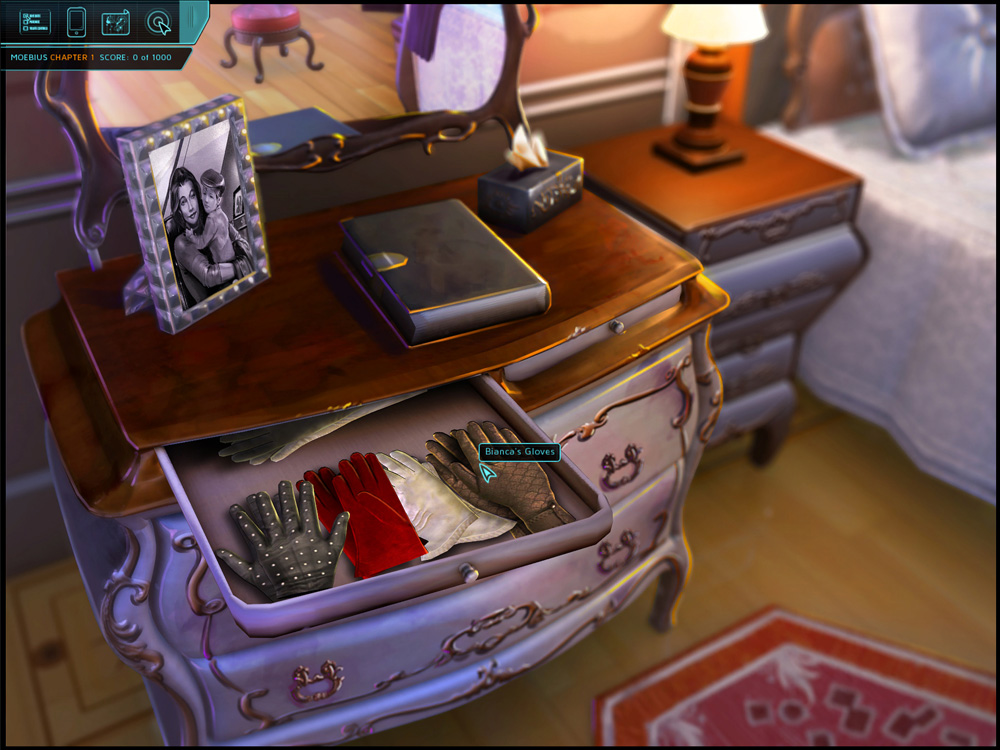
The adventure begins with a job assignment that Malachi must complete, and while the themes and style are firmly planted in the thriller genre that Jane is known for, a few of the gameplay elements offer some interesting experiments during this first job. The first new feature is the ability to zoom into particular objects and people to inspect them a little more closely. This allows Malachi to make deductions about specific details, such as how a woman’s hairstyle reveals something about her personality. Each time you click on a clue, you receive a little more information on the target and earn data points. Data points are Moebius‘s way of providing a score (another nice little throwback to the Sierra games of old.)
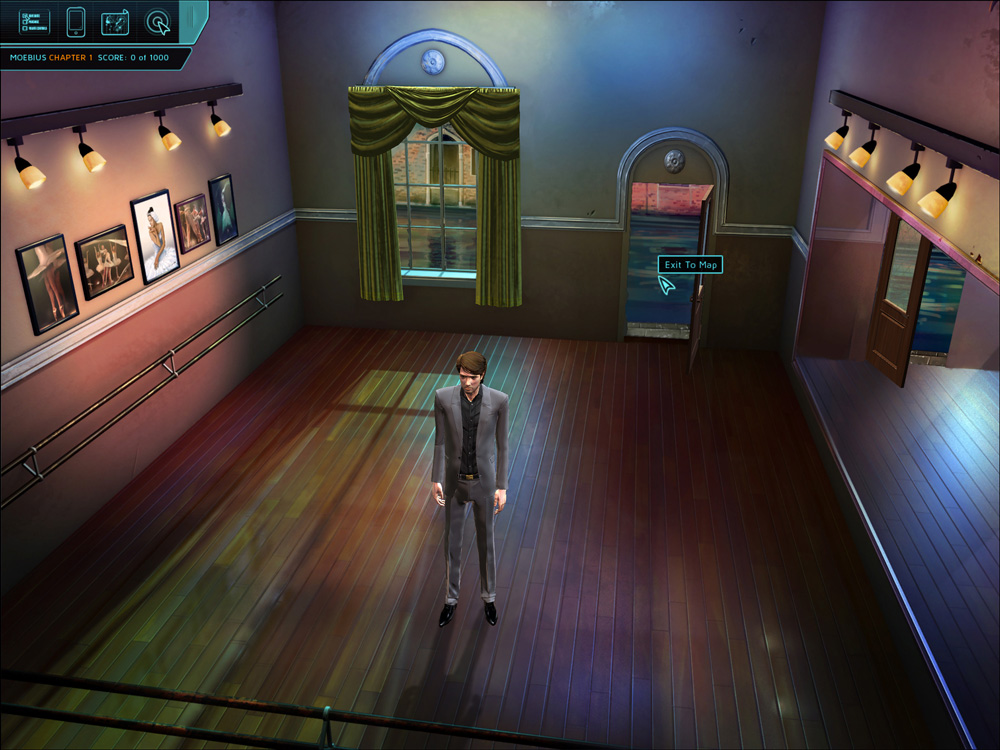
Even more compelling is the menu bar at the upper left of the screen which allows you to access Malachi’s smartphone/PDA. Gabriel would probably have loved to have such a tool available as he traipsed across Germany, because here Malachi is able to access the Internet for research, keep a to-do list which acts like a de facto hint system, take notes during his investigations, and most importantly, to analyze all the data he has collected. While Moebius certainly features classic adventure game logic and inventory puzzles – several are apparent in the first two chapters – using the phone to analyze data is just as significant here.
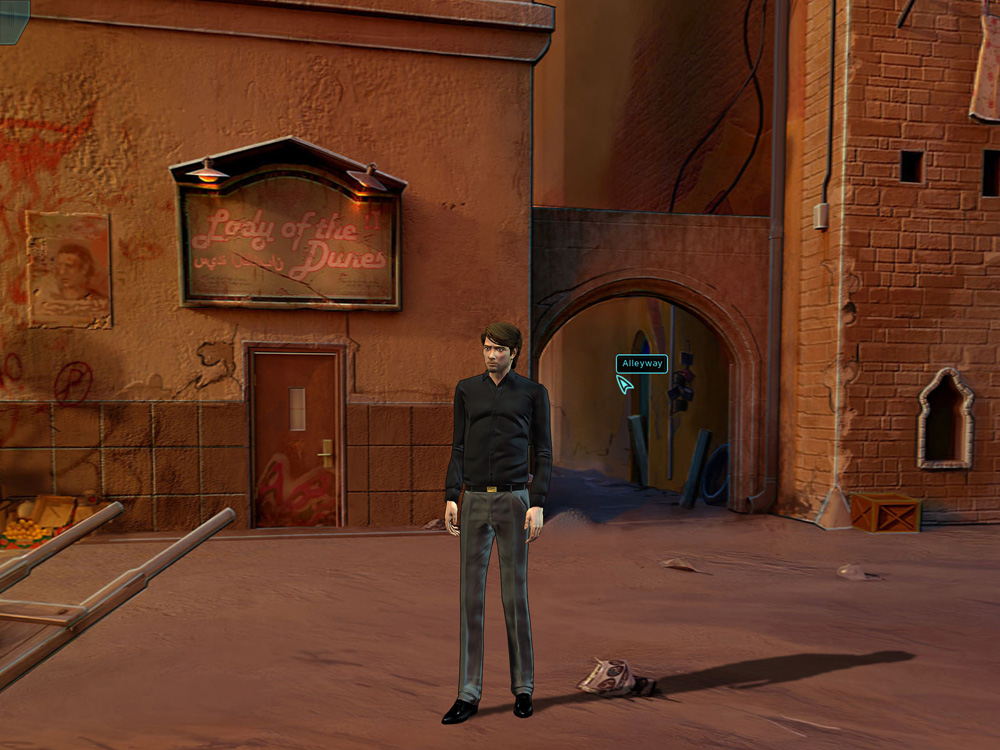
Throughout the game, Malachi must evaluate antiques and will be asked to determine if certain people are eerily similar to famous historical figures. “Malachi’s job is to determine the authenticity of historical artifacts,” said Jane. “Because of his photographic memory, he can match anyone in history.” Through his phone, he is able to compare the information he’s collected with historical fact in order to make conclusions.
In the first two chapters, this feature was more impressive for its wealth of historical information and accuracy than as a challenging exercise. I don’t think anyone can match Jane for her passion in using real world history to provide a captivating sandbox for her heroes to explore. In the first analysis you have to perform, you’re treated to fascinating backstories of Italian painters such as Raphael and Botticelli; in another sequence you have to examine each artistic element of an Egyptian Canopic chest to accurately appraise its value.
Latest Gaming Articles
All Articles