



Following Freeware: February 2011 releases

Balloon Diaspora
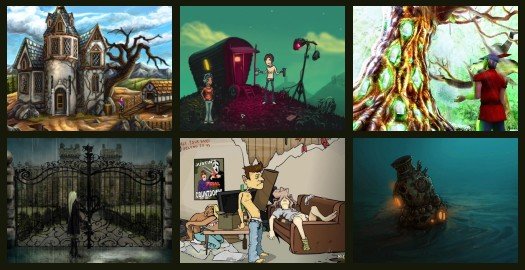
Whilst travelling across a foreign land in your hot air balloon, a mishap results in a crash landing in the grey, smooth depths of an area known as Dark Valley, leaving your balloon deflated and unusable. Fortunately, a local native proves willing to help you in your quest to find material to effect repairs. Together you set out in his own small balloon to search this strange land for the patches you need.
This game from Jake Elliott, also known as Cardboard Computer, has been made using the 3D Unity engine. Whilst this results in some slightly angular forms, most notably the natives, it allows a fully 3D environment that the player traverses via node-based movement. The setting feels strange and foreign, with the character angularity actually serving to enhance this sensation of otherworldliness. Your journey will take you from the deep grooves of the Dark Valley up to the precarious pathways of the Three Spires. It’s an enchanting land, viewed by moonlight and the various lanterns being carried around. Interaction is simple point-and-click and the puzzles are simple, based on satisfying requests from natives so they will supply you with the cloth you need for patches. An interesting feature of the conversations is that they often involve talking about your place in the fictional world. Whilst different choices do not change your ability to complete the game, they do allow you to create an entire backstory that will vary from player to player. Subsequent conversations reflect this background as you discuss such things as your homeland. A haunting soundtrack, which can also be downloaded separately, provides a suitable backdrop to your nighttime exploits.
Balloon Diaspora can be downloaded from the developer’s website.
Beacon
Cosmonaut Valentin Petrostrat is on the re-entry phase of a mission when an explosion knocks out his instruments. Out of control, his capsule plunges into the sea, disabling the radio transponder and incapacitating Valentin himself. With the capsule already buckling under pressure it was never designed to withstand, things look bleak. Fortunately, his capsule is fitted with an automated repair and EVA drone. If this plucky little device can deploy the emergency beacon in time, Valentin could still be saved.
In this February 2011 MAGS entry from pinback, you take the role of the small repair drone. The radio isn’t the only piece of equipment damaged in the crash, so some inventory-based improvisation will be necessary to get the beacon operational again, placed outside the capsule where its signal can be heard. You will also need to deduce the password for an on-board storage compartment, a tricky task given the only person likely to know the password is unconscious. The look of the capsule is grim and functional, with grey and brown tones dominating. There are also signs of damage from the impact, as water leaks drip in various places. This overall look is highly effective in conveying the seriousness of the situation. The animations are also nicely done, whether Valentin’s limited movement before his collapse or the unfolding of the drone’s robotic arm. The game is fully voiced in radio communications just prior to the crash and a convincingly artificial voice the drone uses for all actions. The backing musical piece adds the final touch to the atmosphere, with its slow deep tones reflecting the ocean floor setting.
Beacon can be downloaded from the AGS website.
Death on Stage
At the Little Piddle magician’s competition, Stanley Biscuit dreams of stardom. Sadly, his skills at sleight-of-hand do not quite match up to his vision, and he is ignominiously booed off stage. Taking pity on the poor fellow, the theatre manager advises him of three things that could turn his disastrous performance into a successful act. With the offer of a chance to try again if he can achieve these three changes, Stanley sets off to consult his fellow contestants in the hope of achieving mystic fame.
Duncan “DuncanFx” Frowde’s winning entry in the January 2011 MAGS contest takes a figurative approach to the “death” theme; that of an act dying on stage. This approach allows for a comedy adventure in which our hapless hero interacts with his decidedly peculiar competition in his quest for glory. Getting help from such luminaries as “THE GREAT TROMBONO!” (as he always announces himself) requires cunning use of inventory to distract, confuse and persuade. The standard four-action point-and-click cursor is used, and most interactions result in a unique and often humorous response. Settings range from the cheery corridors of the theatre to the disreputable back alley, and the graphics are a bright cartoon style reminiscent of Day of the Tentacle, as are the gameplay and humour. Despite the low resolution, there are also decent animations, such as a dove escaping early in Stanley’s fumbling first magic attempt. A jaunty tune provides the musical backdrop to proceedings.
Death on Stage can be downloaded from the AGS website.
The Experiment: Part 2 – Menacing Darkness
Having been led to an underground laboratory, David Caldwell chooses to join the disparate group of individuals working there. Like him, they all lost a relative in the accident at the Western Institute of Physics, an accident that may not be all it originally seemed. They are not the only ones interested in the incident, though, as an organisation known as Dacron is also investigating it – and them. When the main power goes down, it appears a mole might be at work. Can David work his way through the abandoned lower levels and restore power before it’s too late?

In Pilcz Studios’ Part 1 – The Laboratory, we learned how David came to find the laboratory. Whilst playing that instalment will provide the full background, a brief synopsis is included at the start of this game. The graphics are the same style, with backgrounds drawn in a semi-realistic look and characters appearing slightly more cartoonish. As the laboratory is an old facility co-opted to new research, dark decrepit corridors are common, though the refurbished rooms in use are better decorated. Control is point-and-click for the most part, though the keyboard is used for a reaction-based challenge later in the game. This results in death on repeated failure, but an autosave at the start of the sequence avoids setting the player back too far. The puzzles have been scaled back from the sometimes brutal difficulty of the first chapter, though they are certainly not simple. As well as inventory-based puzzling, you will operate various mechanisms, each providing a unique challenge. The game has a full range of sound effects, and is also fully voiced in Hungarian. Full English text, largely free of the translation problems that sometimes affected the first game, is also available. It is important to check the speech/text settings prior to starting, as there is no opportunity to change them in-game and saved games retain the settings used at the time of save. The game has a serous dramatic tone and ends on a cliffhanger that will leave players wanting more.
The Experiment: Part 2 – Menacing Darkness can be downloaded from the AGS website.
The Secret of Hildegards
Abigail, the young lady Hildegard, receives a letter from her father. Her family hides a terrible secret and it seems that Talbot, her uncle, is intent on unleashing the darkness they have contained so long. Charged with taking her place as head of the household and preventing this disaster, Abigail must return to her family home. Her only clue to what she must do is the final line of the letter: “The time has come to awake Adalar from his dream.”
This Komar Games production is predominantly hidden object-based, though there are also a couple of jigsaws, a slider puzzle and some combination challenges. The hidden object gameplay is varied somewhat, using word lists, silhouettes and the occasional requirement to find multiples of the same item. In the latter case they are usually light sources; these sections performed by the beam of a torch centred on the cursor. A recharging hint button highlights one object at a time and some puzzles are skippable, allowing for easy progress. The graphics are an attractive painterly style with enough detail to make objects recognisable, if not necessarily easy to spot, as you search the ransacked study or the dark tombs of the family pile. These are presented in slideshow format, the only animation being a slightly faster progression through a sequence of stills. A haunting piano melody provides suitable backing, though the transition to the start of the loop is mildly jarring.
The Secret of Hildegards can be played online at Kongregate.
Other new releases
Not all games are created equal, and freeware games especially come in all shapes and sizes. Not to be overlooked, the following list might also be of interest, though these games may be significantly shorter or less polished, more experimental titles than those detailed above, some perhaps only borderline adventures to begin with.
<i>Focality</i> by Drew Wellman – A profoundly disturbing interactive narrative.
The Premature Death of Christopher Combe by Narwhal Games – On the anniversary of his death, a graveyard visit by Mrs Combe finds the residents restless in this survival horror-style adventure.
You Shall Know the Truth by Jonas Kyratzes – Take the role of a secret agent gathering evidence in this hidden object adventure with a thought-provoking message.
Latest Gaming Articles
All Articles