



Casual Collection – November 2011 releases


Haunted Manor: Queen of Death
by Merlina McGovern
Sibling rivalries can be intense. In Top Evidence Studio’s Haunted Manor: Queen of Death, Christie’s homecoming is marred by a house full of the dead and a creepy sibling, Stella, who takes that rivalry to a whole new level. This dark casual adventure is every bit as morbid as its moniker portends: The queen of death reigns over a manor chock full of deceased or dying people, and you’ll have a grand time exploring the spooky home and its surroundings, though it may leave you less then terrified with an over abundance of poorly placed hidden object scenes.
For many years, Christie has been estranged from her twin sister, who was sickly growing up and took up the bulk of her family’s attention. Still, family is family, and when Christie receives an impassioned plea from her sister saying something horrible is haunting the manor and the family is in danger, Christie decides to go home. She’s immediately met with a grim harbinger of things to come when she discovers an overturned carriage on the road, her mother dying within. Something has sucked out her soul, and it’s your job to find out why some monster would do this and try to save the rest of your family in time.
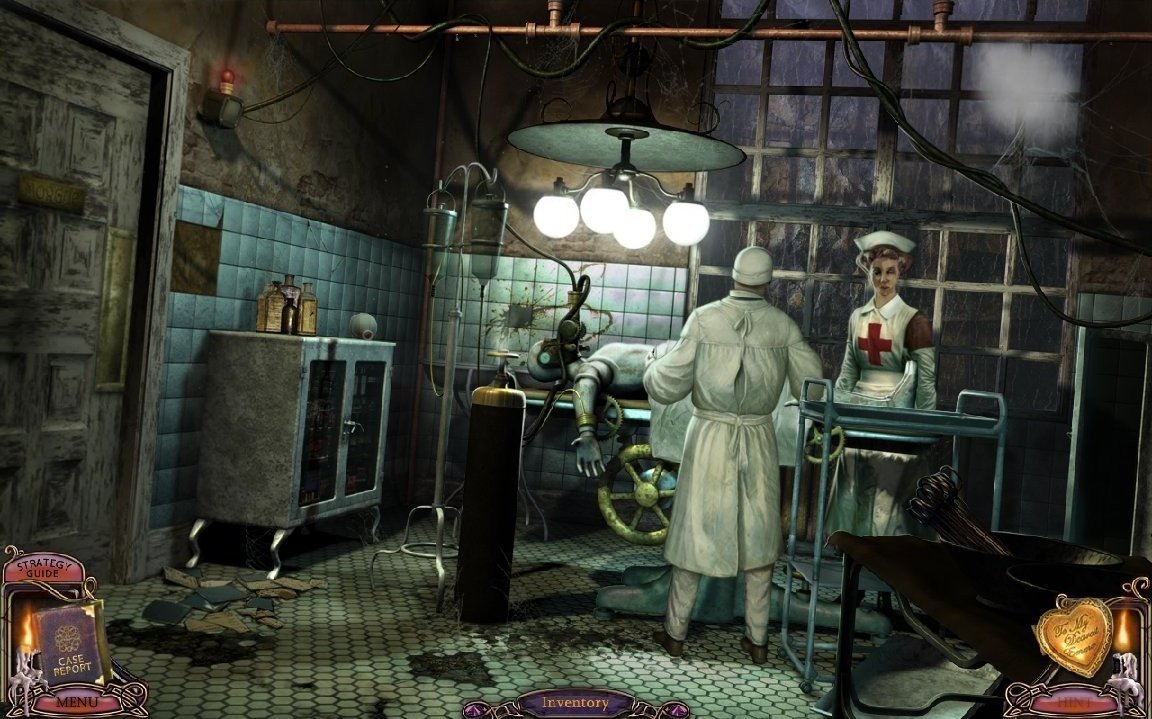
Unfortunately, the lifelessness seems to extend from the premise to the rudimentary animations. A murder of crows circling over the castle are roughly drawn and fly the same flight pattern over and over again in a somewhat ominous, if repetitive, merry go round. Characters don’t move for the most part, simply breathing heavily with their chests puffing slightly in distress, or they may flit briefly in and out of sight. There is a nightmarish-looking monster with an evil head perched atop thin, spidery legs hung with webbed, leathery wings that appears in a variety of scenes with you, most often found sucking out some other poor sap’s soul. However, any urgency or tension disappears as the monster never directly attacks you, merely exiting each scene as a text message warns you that investigating more will bring you too close.
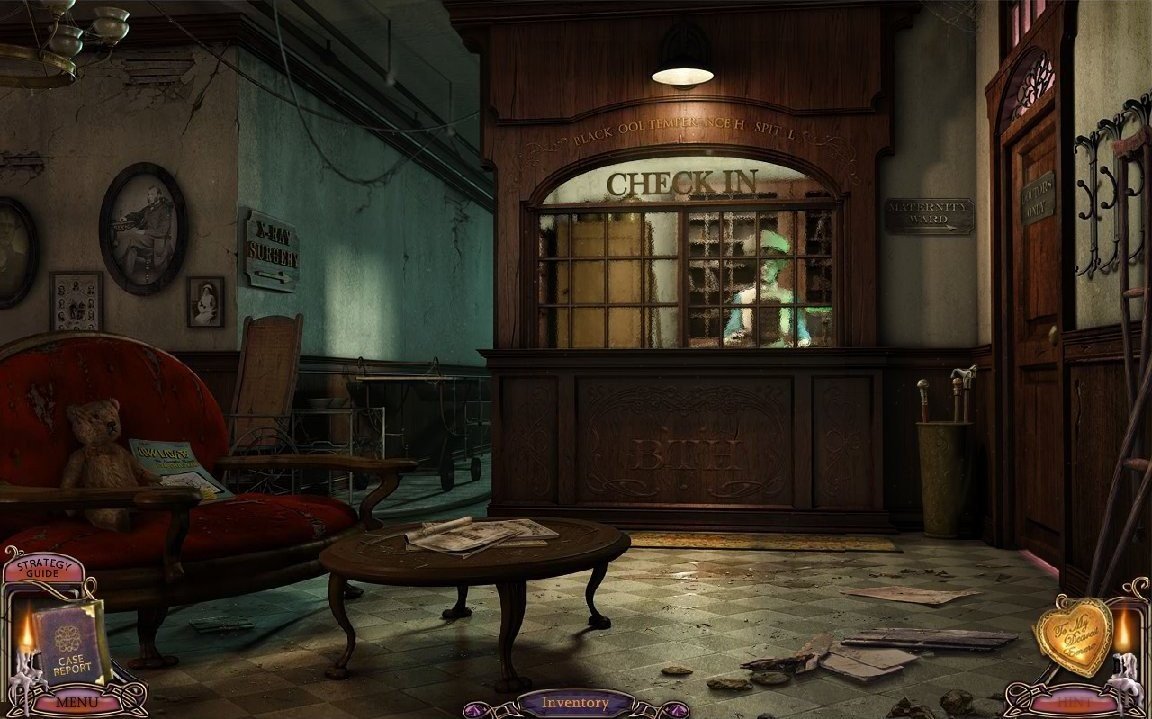
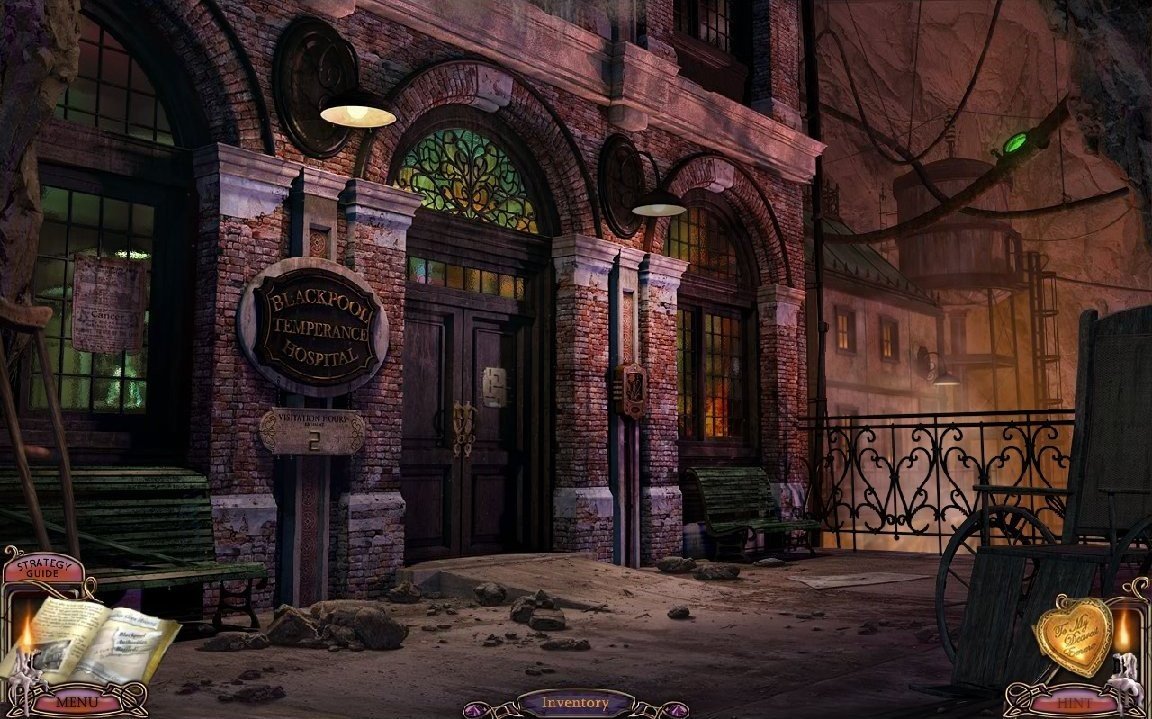
Still, you’ll have a fine time exploring this beautiful game designed in a hand-painted, realistic style. The developers have done a fantastic job of capturing the look of terror and despair on the faces of Christie’s various family members, from her pale mother with her frail arms clutched across her chest to her sadistic sister with dark pleated hair parted severely in the middle. You’ll visit a variety of locations, including an abandoned mine with crumbling stone and broken-down mine carts and the expansive family estate filled with sumptuous music rooms, suits of armor, and rich, wood-paneled walls.
The game opens up with the deliciously melancholic strains from Mozart’s unfinished “Requiem Mass”, but you’ll only get a taste of the masterpiece. The majority of the adventure is filled with a simpler melody highlighted with eerie tinkling. The game makes great use of sound (sadly without voice acting), from the throaty gurgling of marsh insects to cawing crows to the heavy breathing of dying victims, all interspersed with deep despairing moans. If you listen closely, you’ll also hear sinister whispers following you around. The designers could have done a lot more with this effect, but they’ve relied on repeating the same whispered phrase – “I am evil” – over and over again, diminishing its impact with each use.
The inventory puzzles are logical (handles open doors and heavy objects break fragile ones) but sometimes challenging, as you must make do with the tools at hand, even if you have to make one yourself. The logic puzzles range from tilting a labyrinth to get a ball to a desired destination to rotating lock and key puzzles. There are a fair number of these, usually well integrated (one involving clicking a doll’s eyes open and shut is particularly creepy), and difficulty ranges from fairly easy matching types to more difficult sliding ring puzzles. None of the puzzles proved to be overly challenging, though there is a puzzle skip option should you need one.
The big disappointment is in the hidden object scenes, which not only repeat often, but frequently you’ll find yourself looking for the very same items in the same location. Also, the placement and timing of these scenes can serve to stop the story dead in its tracks. At one point you’ll see an evil monster siphoning off the soul of a loved one, but a hidden object scene is right next to it. So you try to save your loved one, right? Nope, you get another item hunt. And unforgivably, for me anyway, the game ends with a series of 13 consecutive hidden object scenes. Sure, 13 is a scary number, but nothing could be less scary than a series of hidden object scenes at the most climactic moment.
Thanks in part to this excessive hidden object padding, Haunted Manor: Queen of Death provides nearly four hours of gameplay as you get to the bottom of the terror haunting your family, while the hour-plus Collector’s Edition bonus chapter has you looking for and attempting to destroy an evil amulet. You’ll get new rooms to explore, but you’ll also be revisiting a limited portion of the areas you already covered in the main game. In either version, while the Queen of the Dead sure sounds regal, this game is more like the pipsqueak of the dead when it comes to genuine scares and tension. You won’t bow before it, but it will provide you with some entertaining gameplay, at least until the repetition sets in.
Shattered Minds: Masquerade
by Jack Allin
Despite the festivities, there’s just something about Mardi Gras that can make a person’s skin crawl. Maybe it’s the anonymity behind bizarre masks. Or maybe it’s the fog that knocks everyone into a paralyzed unconsciousness and removes all traces of their face. Well, at least in Vast Studios’ Shattered Minds: Masquerade, anyway. As a detective called in to investigate this mysterious phenomenon, it’s your task to track down the “Amazing Visage”, magician and impersonator, a “man of a thousand faces” who seems to be behind the surreal disaster that’s befallen New Orleans. Along the way, however, you’ll also have to contend with a masked family of twisted villains who seek revenge for the destruction of their mansion.
The game plays out like most deserted town hidden object adventures, though its few remaining denizens are what help this game stand out. The Boudreaux family members appear sequentially as you progress through the city, each wearing a distinctive mask you’ll need to collect, and each with a devious plot to wreak havoc. All fully voiced, these “shattered minds” are genuinely insane, but in a completely cool, detached way as if completely disconnected from reality. From the botanist who unleashes a formula that causes plants to grow to disastrous sizes to the artist who seeks to make a truly explosive masterpiece, or merely a jealous would-be lover who booby traps her obsession’s wedding, it’s a wonderfully sadistic lot. They lash out because they must, not because they’re evil. (Or so they think.) Unfortunately, the twitchy-eyed Visage is the least threatening of the bunch. He may hold the most power to destroy, but he’s the least menacing in wielding it.
The character models do a nice job of giving these masked villains an eerie presence, and many other macabre touches abound, from ethereal skulls emerging from the mist to preserved bodies in liquid holding tanks. Then there are all the faceless victims you encounter, some of which you’ll need to view up close and (im)personal. Locations include the likes of a casino, an art gallery, a hotel and theater, and of course you’ll have the chance to wander Bourbon Street both above and below ground. Some scenes are nicely designed, but others feel rather stark in comparison, and the somewhat washed-out technical quality (at least on a widescreen monitor) do the latter no favours. The music is something of a let-down as well. The light jazz and film-noir-inspired scores are pleasant enough to listen to, but always seem at odds with the grim circumstances. The mood fares better when it allows ambient sounds during lengthy periods of silence to accompany the action.
As you attempt to fix slot machines, disable security cameras, and mix deadly plant-killing chemical formulas, you must collect numerous inventory items as you go. Most have intuitive uses, but you’ll gather many before you ever know you need them. Some of these come from standard hidden object searches, with one or two interactive items per list. Thankfully, no hunts repeat or are secretly activated, avoiding the bloated repetition of so many casual games. In fact, the game does a good job of shepherding you along its path without feeling overly linear, always offering a handful of screens per area to explore, the hint button advising you if there’s anything currently solvable on any given screen. There are plenty of standalone puzzles as well, most of which consist of familiar tropes like Lights Out, cryptic combination codes, and rotating pieces into place. Several are repackaged alignment tasks, whether levers, dials, or slots, and a couple involve pipes connections, including the climactic challenge that makes you start all over again if you accidentally click out of it.
The streamlined nature of the adventure, plus the absence of repetitive filler, do result in a fairly short game, as you can reach the end in well under three hours. The finale is super-rushed but offers a reasonably satisfying outcome. Whatever goodwill the main game has achieved gets wasted by the Collector’s Edition “bonus” gameplay, however. Not only does it commit the very sins the main game avoids (repetitive hidden object searches, solving the same puzzles multiple times in a row), the obtuse final puzzle is so poorly clued (or explained) that I never did figure it out. It also spins off the Boudreaux family story in an unusual direction that raises more questions than it answers. And to add insult to injury, the final cutscene does nothing to bring closure, merely taunting of unfinished business. If you’re interested in the premise, then, I definitely recommend the standard version only. It may not be very original, but some solid casual gameplay and some great villains help mask any deficiencies.
Latest Gaming Articles
All Articles