



Adventure Architect: Part Three

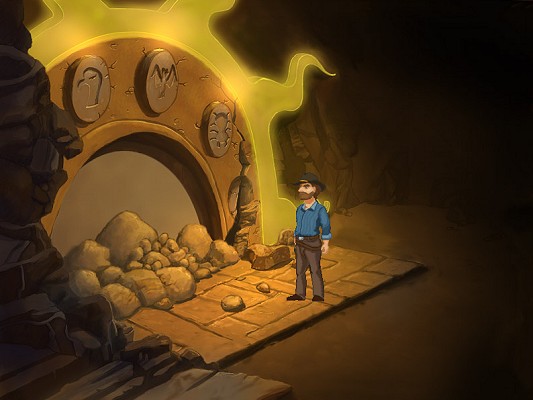
I draw a circle in my notebook and write the words “Old Sierra” inside it. This represents the town. Next to the circle I begin to draw little boxes representing the locations that Jake can visit just outside of town: The gold mine, an Indian village hidden at the bottom of a canyon, a strange rock formation, and so forth. Now I start to draw other circles in different places on the page, representing additional locations I’ve thought of for later in the game. For each one, I ask myself: Does this make sense based on what I’ve established so far? Why would the main character go here? What might he be looking for? What sort of obstacles can I put in his way?
One of my goals here is to figure out the linear story elements—that is, the events that must happen in a certain order, and the facts that I want to reveal at a particular time and place in the story—with the many interchangeable sub-quests that allow flexibility of movement and discovery. I want to take the player on a story that follows a very specific flow without ever intruding on the freedom to explore at his own pace. That’s why I like the idea of tying together a number of distinct locations at the beginning of the game. It gives the player some freedom of movement to explore a large area with a collective back-story that all fits together, and then serves as a launching pad for what I envision as a more linear sprint toward the finish line once the treasure hunt leaves the Old Sierra area.
So now I have the makings of an opening sequence. I repeat the same process for the endgame—drawing a circle and labeling it with the name of the game’s final location, and I create a second flowchart that helps me establish the requirements leading up to this final scene. (Extra credit to anyone who guessed that yes, the endgame takes place inside the lost city of Cibola!) I ask myself what the hero has to have experienced up to this point. Which parts of the story are “extra,” and which parts are critical to ensuring that everything that needs to happen has actually happened? And then I begin to create a bit of a logic puzzle of the “If A, then B must be true” variety to make sure everything fits.
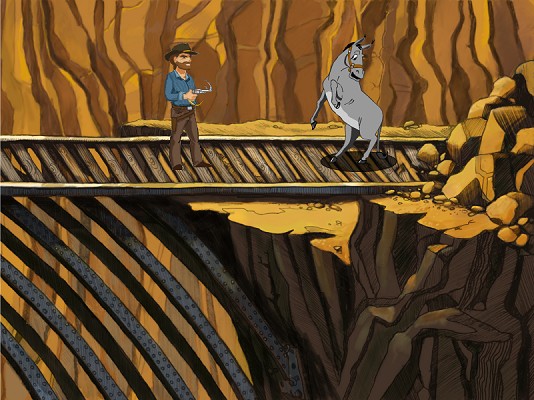
Finally, I take what I know of the beginning and the ending, and I try to figure out how to connect the two. The middle of the game is kind of like an accordion that can stretch or shrink based on the level of my ambitions. My strategy is to take every single idea I have—every possible location, every character, every sub-quest and visual gag, every puzzle idea, everything that absolutely must happen to advance the story—and throw them up against a wall to see what sticks.
When I’ve finished outlining the story, I have a design document that amounts to a macrocosm of the entire game. Before I begin work on a single animation or line of code, I’ll need to hammer out the details in microcosm form. But right now, the macro-design stage is pivotal for making sure that the overall game is cohesive and well paced.
And so, slowly but surely, everything seems to be coming together.
Next: The pre-production phase—puzzles, locations, and concept art
Latest Gaming Articles
All Articles