



URU Diaries: Part 2

Eventually, the time came when we fired up the game and lo, we appeared in our own Relto! Overjoyed, we ran to our bookcase and pulled out the book which would link us to the Neighborhood, the glimpsed but never-really-seen Age that serves as the focus and gathering-place for the Prologue of URU Live. (If you have played the single-player version, this is the book and Age that contains the balconies from which there is no exit.) That is, we pulled the book halfway out… and we were frozen. The book would not come out from the bookcase and there was no way to back away from it. Once again, the only escape was to use the Relto book on our hip to link out of the cutscene. We quickly discovered that the same thing happened no matter which linking book in our library we tried.
This resulted in two more days of back-and-forth with the URU tech support team. (I want to stress that unlike my previous experiences with UbiSoft tech support, the URU Customer Care Representatives were excellent about responding to questions and actually trying to help us solve them.) We got a variety of sometimes conflicting suggestions, from getting a new soundcard to deleting the files in a particular folder (which entailed a 300+ MB download to replace) to deleting the entire character to doing nothing because the problem might be on their end. Eventually, we ended up completely uninstalling/reinstalling the game and starting over with a fresh character.
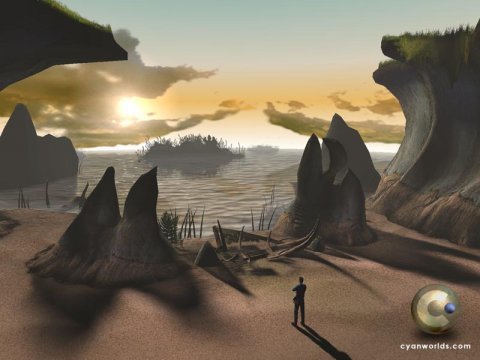
And the day finally came when we were able to successfully link to the Neighborhood. It was gorgeous. People walk the streets of the restored areas of the city greeting passers-by and spontaneously jumping for joy or doing a dance of delight. Others sit by the city’s central fountain in conversation or link to the scenic overlook that provides a telescope for viewing the vista of the enormous underground realm.
And there is absolutely nothing to do.
Well, that’s not completely true. You can play Heek. This is a version of rock-scissors-paper played at a hologram imaging game table by up to five players. Heek is good for up to an hour’s diversion, depending on your attention span. Besides that, your activity is pretty much limited to talking to people and kicking around orange construction cones. I have heard rumors that occasionally the Powers That Be drop a new Relto page into a particular Age that people can hunt for. (Thus the disappearing/reappearing deck in the Relto in which we originally were trapped.) However, I have yet to confirm this for myself. And you often find yourself doing your nothing while in the grip of a maddening “freeze every three seconds” lag as the server struggles to keep up with the volume of traffic. That’s assuming you can login to the game at all. Even as I write this at one computer, I have been trying unsuccessfully to login to the game on the other computer for the last 20 minutes.
Potential URU Live players need to be aware of one important thing going into the game: at this point, the Prologue is still very much in Beta testing. On the one hand, this may seem a bit odd. After all, there had been at least seven months of Beta testing before the game was ever released. Somebody who presumably had knowledge of the game’s status agreed that it was ready to release to an eager public. That person(s) was obviously quite mistaken. I suspect that the suits in marketing who were likely pushing to have URU out for the Christmas shopping season and the nerds in programming who surely knew that URU Live needed a few months’ more work both passed on their advice to some Honcho who totally blew this call. However, said Honcho may also be forgiven to an extent. He was likely basing the nerds’ warnings about how much work still needed to be done on the game on UbiSoft’s previous experience with multi-player online games. He may not have realized that never in the history of online gaming has any project that is so immersive, so detailed, so huge, so visually spectacular and so completely interactive ever been attempted. Timetables based on other games are meaningless when applied to something of URU Live’s scope. So you and I, Constant Reader, end up with a half-finished product that is riddled with more bugs than a colony of Arcturan Mega-Termites.
And that isn’t the end of the bad news. UbiSoft had announced that they expected the “official” version of URU Live to be ready to go by early February. However a “clerical error” over the New Year resulted in the accidental invitation of every person still on the waiting list at the same time. This brought about a massive flood to the only server “shard” currently in operation and forced a temporary shutdown. While the server is back up now, it wouldn’t be surprising if fixing the problems caused by the flood pushed back the launch date of the official version of the game.
But there is hope. Lots of hope. The things that do work in URU Live are beautiful and interesting. If you get bored, you can spend the time getting familiar with your KI. Remember that odd bracelet you picked up out of that machine in Gahreeson? Now you can put it to use. Your KI serves a multitude of functions, with more on the way. You use it to take pictures, to manage buddy lists, to make journal entries, to send intra-game mail, to manage your own Neighborhood (more on neighborhoods next time) and, most importantly, to talk to other players. With true voice chat promised down the road, knowing how to operate your KI will be an indispensable part of enjoying your URU Live experience. Ours seems to function about 85% correctly at this point, and getting to know its intricacies now will flatten the learning curve later.
So, Constant Reader, have I been enjoying my time spent in the Prologue of URU Live? I wish I could say I have, but it has mostly been a source of continual frustration and boredom. But I have no intention of giving up on it yet. Because underneath the technical troubles I can see the promise of what URU Live could be when it is fully operational. And that promise is glorious. A new dimension awaits the serious adventure gamer: puzzles that require several people at once to solve, coordinated effort to physically rebuild ruins, team-based competition where one player doesn’t control the entire team. The question now is whether technology can catch up to the Miller Brothers’ imagination.
[If you missed it, don’t forget to check out Chapter One of Jim’s URU Diaries too.]
Latest Gaming Articles
All Articles