



Puzzling (Mis)adventures: Volume 2 – Lucidity, Max & the Magic Marker, P.B. Winterbottom

The Misadventures of P.B. Winterbottom
I like pie.
No really, I do, though not nearly as much as a certain Bakersburg pie thief. The portly pastry pilferer’s (don’t say that with your mouth full!) insatiable lust for crusty desserts is the stuff of legend, as recorded – again and again, as you’ll come to find out – in The Misadventures of P.B. Winterbottom. This very odd game by The Odd Gentlemen is easily one of the quirkiest, most absurd titles available on the PC and Xbox 360. Yet like its oven-baked subject matter, it also happens to be one of the tastiest, most rewarding puzzle-platforming treats anywhere. Just don’t expect it to be cak… err, a piewalk.
As players learn-by-doing in the opening tutorial levels, it seems the titular villain’s greedy pie pillaging has resulted in all sorts of town damage, and now a giant mystical Chronoberry Pie has come to set things right, whether Winterbottom likes it or not. Not that it matters much to him, whose goal is still the same: see pie, catch pie, eat pie. It’s sort of a redemption through temptation. The only difference is, these new pies are a whole lot harder to catch, and it’ll take a little help from his friends. But since he hasn’t got any friends, he’s going to have to rely on the next best thing: clones of himself. (As if one wasn’t bad enough!)
Somehow or other (hey, it’s a game about magic pies; it’s a little loose on science), the dastardly Winterbutt is transported back in time and given the ability to briefly record his actions and re-enact them through replicated doubles. He’s going to need them, too, if he’s to overcome the many devious obstacles spread out over the course of five worlds and 50 puzzling levels. There are perilous gaps to cross, impossible heights to scale, fire to avoid, timed levers to hit, and pressure plates to weigh down – often all at once, and usually with an unforgiving, unseen timer ticking down.
Since being a glutton isn’t a skill (if only!), the diminutive P.B. will need to make strategic use of his fellow selves to succeed. His only innate abilities (mirrored by his clones) are short jumps and slow runs, but he can also whack what’s in front of him and glide briefly mid-air with his trusty umbrella. When acting together, this allows him/them to climb each other vertically like ants, spring from teeter-totters, and propel themselves like human catapults. It’s a deceptively limited repertoire, as the when and how are just as important as the what, because proper sequencing and perfectly synchronized timing are crucial.
Adding to the challenge, it’s not just the environmental hurdles that need to be cleared, but the individual level conditions as well. Some screens limit you to a minimal number of clones to aid you, while others demand so many that it’s literally hard to get out of your own way. Many levels add the completely arbitrary requirement of collecting pies in a certain order, each remaining active for mere seconds after the last. A few levels scroll past low-hanging ledges and crumbling platforms, but many are just single screens, leaving you free to ponder, plan, and experiment with your approach. You’ll likely breeze through the early levels of each new stage, but some of the later ones will hit you like a… well, a pie in the face, only not as funny.
Just when you think you’re got the basics licked (so to speak), the game introduces new problems that add some welcome flavour, although they aren’t always integrated as seamlessly as they could. Your regular blue-tinged clones are the only ones who can collect blue pies, red clones are hostile and kill the real P.B. on contact, and clones near the end of the game will inexplicably begin running in your direction with umbrella-whapping malice (a fact you can use to your advantage, if a little hard on the hindquarters). In one world, Winterbum loses command of his powers, so clones can only be generated from the same fixed portals. Such changes are duly noted in subtitled instructions, but they’re introduced (and often abandoned) so abruptly that the shift can be difficult to adjust to on the fly. A more user-friendly introduction of whole new mechanics would have been beneficial.
While it’s possible for Winterbottom to die, he simply respawns immediately from a nearby portal when he does. Clones aren’t so lucky, disappearing in a little puff of smoke. You won’t be growing too attached to your duplicated selves, however, since you’ll regularly be zapping them yourself. If you realize you’ve botched a clone recording, just wipe it out and try again. Even if your recording is correct, you may find yourself needing to repeat it, as it’s easy for your clones to become disoriented if bumped off their pattern. At times this can be a nuisance, as you can only undo your last recording, and with all the trial-and-error needed here, it’s not always immediately apparent when your sequence is futile. For the most part, though, the levels are compact and quick-paced enough that it’s easy to retrace your steps.
Given P.B.’s limited number of skills, the controls are very simple to master, whether using the keyboard or gamepad, and you can rebind them to your liking if you don’t like the default setup. Like most puzzle-platformers, this game is far more about tactics than dexterity, but quick thinking and decent reflexes are still helpful in the levels with tight time restraints or particularly devious obstacles. If you do get stuck, either mentally or physically, there’s no way to bypass a troubling level, and very little opportunity to explore, as progression through Winterbottom’s misadventures is almost strictly linear, accessed through a hub-based “Theatre of Time”. Only the third and fourth worlds can be played simultaneously, and even then, within each world the ten levels can only be completed in order, giving you a choice of only two levels at any one time at most.
Then again, there are always the “bonus shorts” to play for a change of pace. There are 30 of these available (also unlocked as you progress in the main game), and here the goal isn’t simply to collect the requisite pies, but to do so in a limited time or using the fewest number of clones. These “shorts” (which really aren’t any shorter than most regular stages) are just as enjoyable to play as the main “movie” levels, though actually meeting the level requirements is far more challenging.
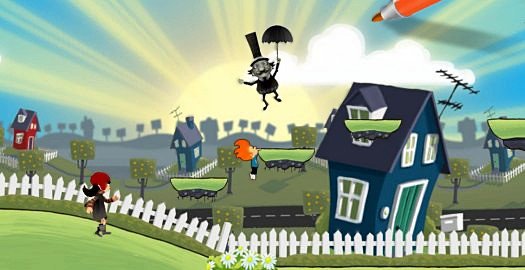
Why are the main missions called “movie” levels? Because this game features a ridiculously charming silent movie-themed presentation. “Filmed” almost entirely in noise-filtered black-and-white, with just a few slight traces of colour weaved in for effect, a series of clever rhyming poems and caricatured artwork introduce each mission. The levels themselves are set in a distinctive Victorian era landscape of off-kilter proportions, taking players from crooked city streets to the upper levels of a clock tower and the lower depths of the sewer system, passing through the heat of a blazing bakery in between. All the while, a piano-heavy, pre-talkie period soundtrack playfully provides the musical backdrop. The tunes are pretty repetitive, but they’re just so darn peppy that you won’t mind. The more ominous setting-specific chords are all struck as well, with one world offering a kind of Elfman-meets-Ragtime vibe, and another skillfully adding musical bell gongs to the numbers.
Without accounting for any serious stuck time (which I encountered two or three times), The Misadventures of P.B. Winterbottom isn’t a particularly long game, as many levels can be whipped through in mere minutes, the bonus levels offering the only source of replay value. But whether you spend three hours or double that, it’s time very well spent, and its outrageous budget price at Steam (or even twice the equivalent on Xbox LIVE Arcade) makes it even more enticing. Its story is crust-thin and there are minor quibbles to be sure, mainly centered around new mechanic integration and the occasional jarring difficulty imbalance, but the wonderful old-time aesthetic, enchanting backdrop, and frequently clever puzzle design make up for that and more. There’s no demo available for a sample taste, but it’s worth every bite, so if you have any platforming ability at all, dig in!
Latest Gaming Articles
All Articles