



Following Freeware: September 2013 releases

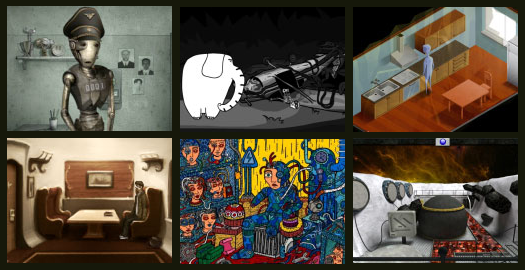
This month, you can become a cyborg trying to break out of a scientific facility or an android breaking into the dark recesses of an underground bunker. Explorers can try to find their way around a surreal house, delve into the deeper realms of their own sleeping minds or journey into fantastical pocket universes. Alternatively, you could take on such diverse goals as selecting a target to assassinate, rebuilding an elephant’s beloved vacuum cleaner, or simply getting a drink on a disturbing overnight train. All these await you in this month’s roundup of releases from the freeware scene.
Postmortem
You are an Agent of Death. Your secretary gives you the assignment of going to a fundraising party and taking one life there. It doesn’t matter who you kill, but you have to kill someone. She gives you the choice to go as a male or a female. So you choose your sex and go to the party, which is in Galicia, in the city of Antrim, on October 18th, 1893. As you talk to the guests you soon find out that the region is in turmoil and is on the brink of a civil war between the Newagers, who are mostly entrepreneurs from outside the area who build factories and make fancy new stuff, and the Oldagers, who are afraid the newcomers will change the things they love and the way they live so profoundly that they will lose their culture.
In Postmortem, by Jakub Kasztalski, most of the action takes place inside the house of the Newager Bill Seldon, who gives the fundraising party there. You can move your character around in a 3D environment with the keyboard’s WASD or arrow keys. A few other keys have specific actions assigned to them, like choosing a target to kill or interacting with a guest or an item. There are a few locked rooms which you can open once you have the keys to them in your possession. When you need an item that is in your possession, the game will use it automatically when you interact with the appropriate item or guest.

The other guests also walk around in the house, so you can easily walk up to them and talk to them. When you talk to a character, his or her face is shown on the screen next to a voice bubble in which the character’s lines are shown above, with one or more possible answers you can choose underneath that. The answers can be chosen by pushing the corresponding number key. Only the first sentence of a conversation is spoken, with adequate voice acting. The environment and the characters are nicely drawn in a style that resembles the old Japanese children’s cartoons. All characters are easily recognizable by their features – their faces and the way they dress. An icon appears when you approach a character or an item with which you can interact. Classical music is played continuously in the background. You can set the volumes of all the noises, as well as the size of the window in which the game plays in the setup menu.
There are no real “puzzles” per se, but you find out a lot about the guests by talking to them and wandering around the house reading everything you can get your hands on. The characters are all very detailed; they have pasts, ideas about how to deal with the current political situation, and hopes and dreams for the future. They all talk freely to you about what is on their minds and usually give you honest answers to everything you ask. What makes this game unique is that you can try to convince people to change their minds about certain issues or take certain steps to improve their lives. You can even ask people what they think about each other. In fact, you can choose which role you play. Will you stay neutral, take a side or even wreak havoc amongst the guests and their relations with one other? Choosing who to kill then turns out to be a quite difficult task, as it decides the future of the community. The game also has an online feature that shows you how your choice compares to others.
Postmortem can be downloaded from the developer’s website. There is an option to pay for an Extended Scythe Cut, which includes (amongst other things), an extra character and old 16-bit character sprites.
Deeper Sleep
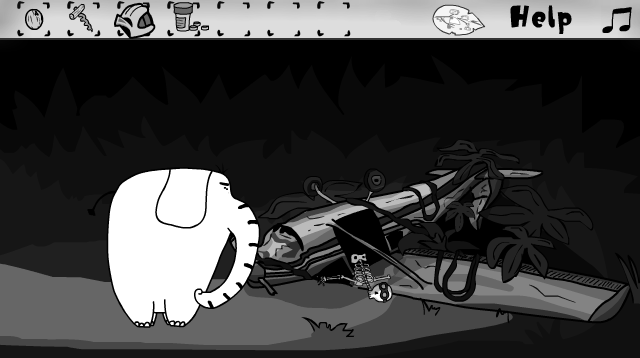
Deeper Sleep is the sequel to scriptwelder’s Deep Sleep. In short, it’s a first-person 2D point-and-click horror adventure where you play someone trying to make sense of what is only a dream and what is reality. This game continues its predecessor’s story, beginning with the protagonist looking for information concerning the nature of lucid dreaming. Of course, the only way to do this is to study up, so Deeper Sleep begins with searching for material at the local library. There, what at first seems real quickly transforms into another terrifying nightmare as the building shifts and you find yourself trying to escape from a deserted manor.
This game deliberately looks older than it is, incorporating a crosshair cursor and pixelated graphics to invoke the adventure design of the early ’90s. The retro look and film-grain effect is used to make you feel vulnerable, as if you are constantly looking into the unknown. The game plays with the visuals further by darkening rooms and decreasing colour contrast. There are a range of motifs used which naturally link to disturbing material such as empty children’s rooms with unused toys, dead animals hanging from the walls, and paintings of clowns which shift from cheery demeanours to angry ones. When the game begins, it issues an instruction to wear headphones and to play the game in the dark. Often you can only hear your own footsteps, but at times this is coupled with things that sound like they are moving in other rooms, making you wonder who is making the noise and whether it is a friend or foe. Likewise, music is scarcely used, but when it is it’s a disturbing orchestral score.
Latest Gaming Articles
All Articles